Просмотр новости
Найдите то, что Вас интересует
 Спутники
 РН
РН SpaceX
 Роскосмос
 NASA
NASA
СпутникиРНSpaceXРоскосмосNASAFormer officials told the House Intelligence Committee that U.S. agencies have not kept pace with China’s efforts to steal technology.
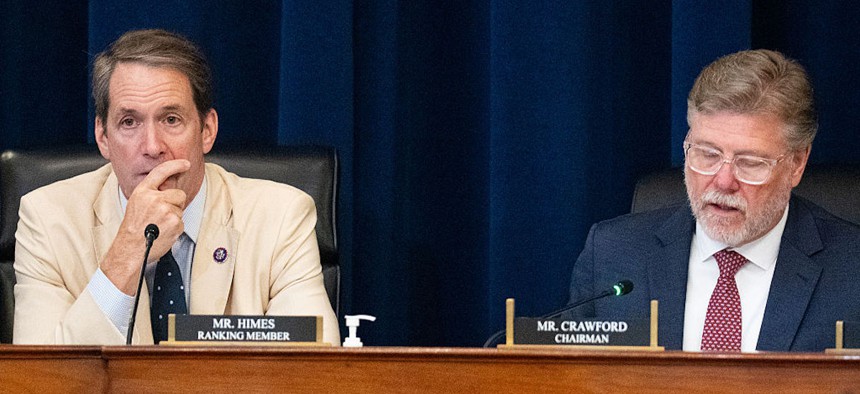
Ranking member Rep. Jim Himes, D-Mass., left, and chairman Rep. Rick Crawford, R-Ark., conduct the House Select Intelligence Committee hearing on "25 Years After 9/11: Confronting the Next Generation of Threats" on Tuesday, July 21, 2026. Bill Clark/CQ-Roll Call, Inc via Getty Images
The U.S. intelligence community needs to devote more resources to protecting American artificial intelligence companies from foreign espionage, former officials told the House Intelligence Committee on Tuesday, arguing that China will use a range of intelligence-gathering techniques to steal proprietary AI technology and advance its own military and economic goals.
The hearing, focused on emerging threats to the U.S. in the 25 years since the Sept. 11, 2001, terrorist attacks, also highlighted AI’s growing role across a range of national security concerns, including cyberattacks, autonomous drones and foreign influence operations.
“Of course, our intelligence services and agencies are going to have secrets that are always going to be of top desire for foreign intelligence adversaries, but if you’re [China’s Ministry of State Security] today, you’re looking at frontier model companies,” said Frank Cilluffo, a former George W. Bush homeland security official who leads Auburn University’s McCrary Institute for Cyber and Critical Infrastructure.
“I think we’ve got to actually rethink counterintelligence. It’s not just the traditional spy-versus-spy, information-versus-information,” he added. “It’s who holds the keys right now, it’s not going to be in government alone.”
Access to proprietary U.S. AI research is valuable to foreign adversaries because it can help them close technological gaps without bearing the cost and time of developing those capabilities themselves.
U.S. officials have several times assessed that China has stolen proprietary national security information, notably data on military aircraft. More recently, the White House and major U.S. AI companies have accused Chinese firms of conducting distillation operations, in which developers covertly use advanced American-made AI models to improve their own.
“The counterintelligence threat has lagged way behind,” said retired Lt. Gen. H.R. McMaster, who served as national security advisor during President Donald Trump’s first term. “I think we have a lot of work to do,” he said, describing how, over the years, U.S. devotion to counterterrorism efforts after Sept. 11 drew away resources that track China’s efforts to embed spies and other researchers into American firms.
The range of counterintelligence targets is broader now, and especially includes private companies, said Ben Buchanan, who served as the Biden administration’s White House special advisor for AI.
Counterintelligence operations will also evolve with AI, he said.
“Of course cyber operations have already changed, but even if you look at things like human intelligence and detecting human intelligence operations, it is a different technical paradigm that yields different kinds of analysis that AI alone can do,” Buchanan said.
He also criticized the Trump administration’s recent moves to ease restrictions on advanced chip exports to China.
“America has a large structural advantage in AI due to the democratic ecosystem of producing chips, and we should exploit that structural advantage to the fullest,” Buchanan said. “We should be much more aggressive on enforcement and smuggling to stop China from trying to catch up.”
Many individual states are also not well equipped to track and respond to Chinese spying efforts, said Seth Jones, a former U.S. Special Operations Command official who now leads the Defense and Security Department at the Center for Strategic and International Studies.
Recent quantum computing executive orders have focused, in part, on tasking the FBI and the intelligence community with better protecting the nation’s quantum research from foreign spying.
The White House has directed national security agencies to help safeguard advanced U.S.-made AI from foreign threats, but it has not established a dedicated counterintelligence framework equivalent to the quantum technology directives.