Просмотр новости
Найдите то, что Вас интересует
 Спутники
 РН
РН SpaceX
 Роскосмос
 NASA
NASA
СпутникиРНSpaceXРоскосмосNASAThe EPA reports that Americans spend approximately 90% of their time indoors.
The EPA reports that Americans spend approximately 90% of their time indoors.

Our indoor air quality is often vastly underestimated. According to the U.S. Environmental Protection Agency (EPA), the concentration of certain pollutants can be two to five times higher indoors than outdoors, sometimes even higher. Equally, the EPA reports that Americans spend approximately 90% of their time indoors. This means that the majority of our daily exposure to air pollution may be taking place inside our own homes (EPA).
Article continues below advertisement
Often, we associate pollution with highways and industrial skylines. But for many households, indoor air pollution may be happening quietly in kitchens, bedrooms, and living rooms.
The invisible pollutants in everyday lifeIndoor air pollution is far less visible than outdoor pollution. The familiar indicators, such as haze, fog, or other visible emissions, are rarely present indoors. However, pollutants can still build up slowly over time through routine daily activities.
Common sources include:
Article continues below advertisement
Modern homes are also more energy efficient and tightly sealed, meaning common pollutants don’t disperse as easily.
The EPA has long warned that poor indoor air quality can contribute to headaches, fatigue, asthma flare-ups, and respiratory irritation (EPA). In turn, global health authorities have stepped up and taken a stronger stance than ever before.
Article continues below advertisement
The World Health Organization (WHO) identifies household air pollution as a major public health risk worldwide. They state that exposure to indoor air pollution is linked to pneumonia, stroke, heart disease, chronic obstructive pulmonary disease (COPD), and lung cancer (WHO).
While the most severe cases are associated with solid fuel use in lower-income regions, the WHO also emphasizes that even in high-income countries, exposure to fine particulate matter and chemical pollutants indoors contributes to measurable health impacts.
Fine particulate matter, especially PM2.5, is particularly concerning as these particles are small enough to enter the bloodstream. Long-term exposure has been associated with cardiovascular and respiratory disease (WHO; EPA).
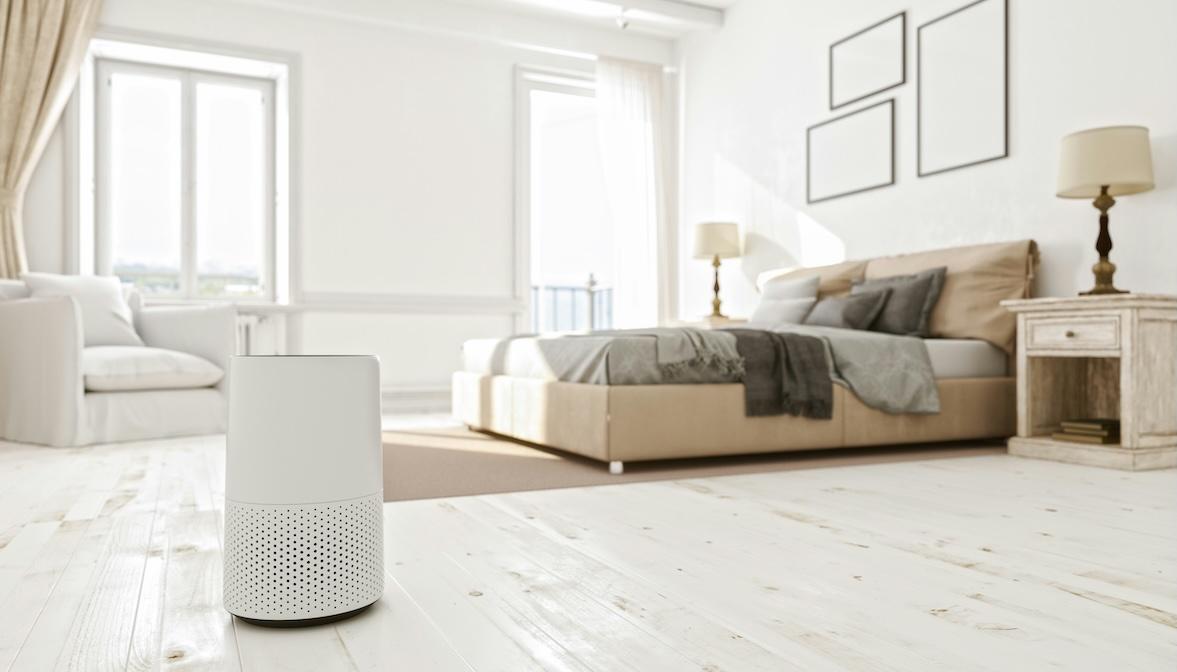
If you regularly wake up congested, with a dry throat, or still feeling tired despite a full night’s sleep, the air in your bedroom could be a significant part of the problem.
We spend around a third of our lives sleeping, often in rooms with closed windows and limited air circulation. During the night, allergens, dust, volatile organic compounds (VOCs) from furniture, and fine airborne particles can build up, affecting the quality of the air you breathe while you rest.
Article continues below advertisement
Research increasingly suggests that air pollution exposure may interfere with sleep quality, contributing to nighttime awakenings and respiratory irritation. Cleaner air at night can reduce allergen load and congestion, potentially supporting more consistent sleep cycles.
Poor air quality can exacerbate allergy symptoms and nighttime discomfort, factors that directly impact sleep depth and recovery. For many households, improving indoor air quality in the bedroom may be one of the most immediate and noticeable changes.
Opening windows can help improve air circulation, but only when outdoor air quality is of good quality. In areas affected by wildfire smoke or heavy traffic, bringing outside air in may introduce more pollutants than it removes.
Standard HVAC systems do circulate air, but many are not designed to capture the smallest, most harmful particles or effectively remove VOCs.
That’s where dedicated air purification systems come in, but not all systems perform to the same standard.
Article continues below advertisement
If you’re exploring how to improve air quality at home, experts recommend focusing on measurable filtration standards.
The following are the key things to look for:
Article continues below advertisement
Improving indoor air quality also raises an environmental question. Air purifiers use energy and require shipping, which means that sustainability practices matter.
Cleaner indoor air doesn’t have to conflict with broader sustainability goals. Brands like Eoleaf combine an eight-step filtration process with carbon-neutral shipping, showing that performance and sustainability can go hand in hand.
Improving air quality at home isn’t one single action, It involves layering daily habits with long-term solutions.
These include:
For households managing allergies or urban pollution exposure, these steps can reduce airborne irritants and improve overall respiratory comfort.
Article continues below advertisement
Outdoor pollution receives significant attention, but indoor air is the air you breathe most often. As noted by the EPA, most Americans spend the majority of their time indoors (EPA). According to the WHO, household air pollution remains a significant global health concern.
For most of us, indoor air quality is one of the few environmental health factors we can actively control.
Cleaner air may mean fewer allergens, better sleep, and reduced long-term exposure to pollutants that health authorities have been documenting for years. For those searching for an air purifier for allergies, medical-grade filtration can significantly reduce pollen, pet allergens, and dust in sleeping spaces.
When taking into consideration the significant amount of time spent asleep, bedroom air quality remains an often overlooked environmental factor.
| # | Наименование новости | Тональность | Информативность | Дата публикации |
|---|---|---|---|---|
| 1 | "Ромир": "совы" чаще других проводят в сети более 8 часов в день | 0 | 0 | 05-07-2025 |
| 2 | Исследование: россияне в выходные спят около 9,5 часов | 0 | 0 | 14-08-2020 |
| 3 | Data / Hogares mexicanos destinan cada vez más tiempo a limpiar y mantener la casa | 0 | 11.13 | 18-08-2026 |
| 4 | Опрос: каждый пятый российский ребенок проведет лето дома | 0 | 0 | 27-05-2021 |
| 5 | Исследование: более четверти молодых людей в России живет с родителями | 0 | 0 | 12-01-2021 |
| 6 | Контент блогеров занял четверть времени просмотра видео в США | 0 | 5.92 | 23-07-2026 |
| 7 | Database reveals how Americans use water | 0 | 7.66 | 12-02-2026 |
| 8 | "МТС AdTech": каждый 10-й россиянин делает ремонт регулярно и с удовольствием | 0 | 0 | 15-08-2025 |
| 9 | Which Americans are most likely to have spoken with a local journalist? | 0 | 5 | 29-06-2026 |
| 10 | Исследование: в среднем россияне проводят в соцсетях три часа в день | 0 | 0 | 06-10-2021 |