Просмотр новости
Найдите то, что Вас интересует
 Спутники
 РН
РН SpaceX
 Роскосмос
 NASA
NASA
СпутникиРНSpaceXРоскосмосNASASearching for tips on how to grow healthy plants? Embracing sustainable farming and gardening means prioritizing plants' basic needs & improve your gardens immune system.
Perhaps not every gardener will want to manage a ground cover mix, especially in a small garden space.
However, ground cover is part of maintaining a diversity of year-round growing roots in my low-input system with farm-grown fertilizers that multi-task as habitat for natural enemies.
Weed suppression can also be a part of that system, but it requires diligent management of weed-crop interactions.
My idea of a healthy plant has changed over the past 40 years. I once thought that the biggest, greenest, most vigorous, nitrogen-filled plants would give me the best quality and highest yield. (Thus my dedication in times past to using manure-based compost.)
A healthy plant is one in which the main nutrients (such as nitrogen, phosphorus, and potassium) and the micronutrients are all balanced in relation to one another. No one nutrient should be out of a healthy range.
Maintaining Nitrogen LevelsFor example, I still strive to grow vigorous plants, but now I understand that high levels of nitrogen in plant tissues don’t necessarily make plants healthier.
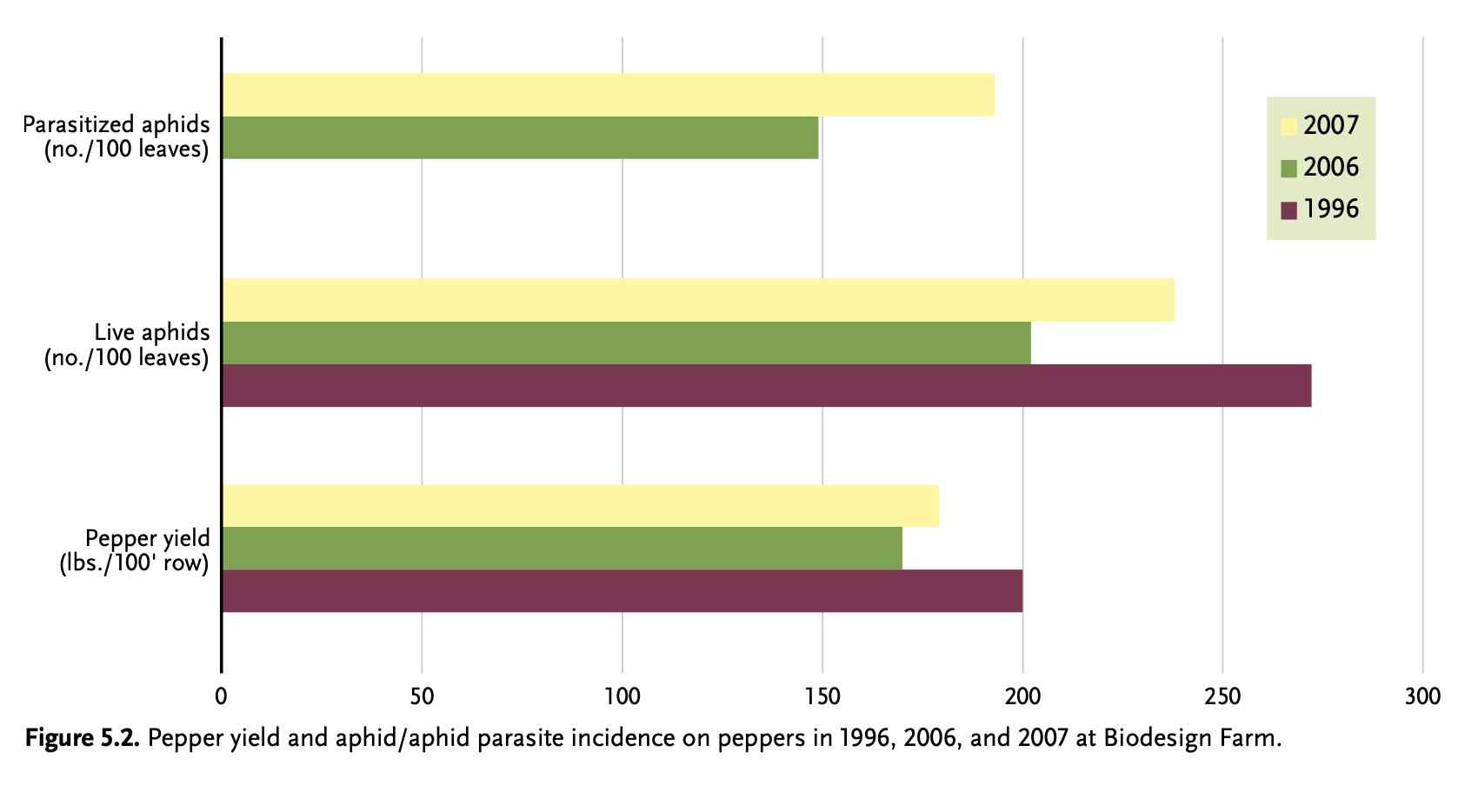
In fact, high nitrogen levels have been shown to make some crops more susceptible to insect pests such as aphids, thrips, and mites.
Lower concentrations of soluble nitrogen (specifically nitrate-nitrogen) in plant tissue seem to make crops less susceptible to feeding damage by most types of insects. In several studies, applying fertilizers that rapidly release nitrate-nitrogen led to increases in sap-feeding insects.
And in one review that spanned 50 years of insect and nitrogen research, 135 studies showed more plant damage and/or greater numbers of leaf-chewing insects and mites in nitrogen-fertilized crops. Only 50 studies reported less pest damage with nitrogen fertilization.1
Just as important, fast-release nitrogen fertilizers often cause plants to reduce investments in their “immune system”— their natural chemical defenses designed to fight off insect attacks and disease.
Achieving BalanceHigh nitrogen in the soil around plant roots can diminish the ecological efficacy of important interactions among plant roots and microbes that help to suppress insects and disease.
And as I’ve already discussed, it is becoming clear that higher-carbon, lower-nitrogen fertilizers increase soil microbial biomass and diversity as well as root-microbe interactions.
These beneficial belowground soil microorganisms help plants better tolerate stress and streamline nutrient uptake, leading to optimal plant nutrient balance. All in all, healthy plants are those that are connected to and interacting with a healthy, microbially active soil agroecosystem.
Here’s the ecological principle that turns out to be a recipe for providing optimal plant nutrient balance:
Focus on carbon fertilizers. Prioritize slow-release, plant-based carbon fertilizers rather than fast-release nitrogen fertilizers.
Generally what I mean by “carbon fertilizers” are plant residues that have a higher carbon-to-nitrogen ratio (C:N ratio).
So far this nutrient balance has helped me to maintain pest suppression without using any pest sprays on fruit or vegetable crops for the past 7 years.
However, during a long heat wave in 2022, some vegetable pests reached economically damaging levels (cabbage worms on kale, flea beetles on arugula, and root maggots on turnips), and I had to decide to accept the damage.
Beneficial insects eventually suppressed the cabbage worms on the kale crops, but we had to cover all successive arugula crops with row cover to manage flea beetles.
Choosing Fertilizer: It DependsIt’s not necessarily the case that the lower-carbon living mulch I use as fertilizer always results in a better nutrient balance.
As all ecologists are fond of saying, “It depends.”
It depends on your soil and the state of its microbial health, the nutrient requirements of the crop you are growing, and how early you want to get your crop to market or to your homestead table.
Some infertile, degraded soils with meager microbial activity may need a heavy shot of a nutrient-rich organic amendments. Some soils may respond best to a turbojet intervention of plowing down a rapid-release, succulent legume cover, or even an application of manure-based compost.
Cycling FertilizersBut generally, the way to provide optimal nutrient balance is to cycle organic residue fertilizers and carbon through the soil microbial community. I draw the analogy to the fact that humans need fiber as well as protein and vitamins in their diet.
That brings us right back to this ecological principle:
Maintain growing roots year-round. Grow and maintain plants with living roots to keep the soil covered year-round and to feed the rhizosphere a steady, balanced diet of carbon and nutrients.
If we think only about crop nutrients, especially the big three of nitrogen, phosphorus, and potassium, we might forget the underground microbial labor force we are supposed to be nurturing as we build habitat for natural pest suppression.
Our goal is three-part:
Crops demand different nutrient levels at different growth stages. Generally, lower C:N ratio fertilizers (higher nitrogen) work better in the early growth stages (germination and first rapid leaf growth) and higher C:N ratios are best for the later stages (fruiting or crop maturity).
We can control fertilizer carbon quality through the choice of maturity stage of plant residues.
How to Grow and Maintain Fruit Trees: General Fruit Tree Management
| # | Наименование новости | Тональность | Информативность | Дата публикации |
|---|---|---|---|---|
| 1 | A Passion For Plants: In Botanical Time | 0 | 21.82 | 20-06-2026 |
| 2 | Harvesting 101: Basics of Harvesting Herbs, Roots, Fruits & More! | 0 | 22.82 | 16-07-2026 |
| 3 | How to Manage Garden Pests (Without Pesticides!) | 0 | 16.89 | 29-07-2026 |
| 4 | Living Mulch: A Better Way to Cover Ground | 0 | 21.9 | 10-07-2026 |
| 5 | Capturing the Crunch: How to Harvest and Store Cucumbers | 0 | 24.12 | 24-07-2026 |
| 6 | About Thyme: Growing, Harvesting, and Drying Thyme | 0 | 22.71 | 20-07-2026 |
| 7 | Почему клубни картофеля не всходят? Главные проблемы и как их избежать до посадки | 0 | 5 | 01-07-2025 |
| 8 | После дождей растения под угрозой: как защитить урожай от болезней | 0 | 5 | 09-07-2026 |
| 9 | Как спасти урожай картофеля от вредителей и гнилей: инструкция для дачного сезона | 5 | 7 | 08-07-2025 |
| 10 | От подоконника до сада: 6 полезных приложений для ухода за растениями | 0 | 7 | 18-06-2026 |