Просмотр новости
Найдите то, что Вас интересует
 Спутники
 РН
РН SpaceX
 Роскосмос
 NASA
NASA
СпутникиРНSpaceXРоскосмосNASAOnly July 30, 2026, China’s National Intellectual Property Administration (CNIPA) released the revised Measures for Administration of Priority Examination of Patents (Order No. 85) (专利优先审查管理办法(局令第85号)) effective September 1, 2026. Unlike the United States Patent & Trademark Office’s (USPTO) prioritized examination system, foreigners do not appear eligible to use China’s priority examination system.
Priority Examination is available for:
(i) Invention patent applications that are in the substantive examination stage and have not yet been given initial treatment. Initial treatment means that the examiner has begun examination and issued a notification.
(ii) Utility model and design patent applications;
(iii) Re-examination cases of invention, utility model and design patent applications (hereinafter referred to as re-examination cases);
(iv) Invalidation cases concerning invention, utility model and design patents (hereinafter referred to as invalidation cases).
For invention… Read the complete article here...
© 2026 Schwegman, Lundberg & Woessner, P.A. All Rights Reserved.
CNIPA Releases Revised Measures for Administration of Priority Examination of Patents Excluding Foreigners
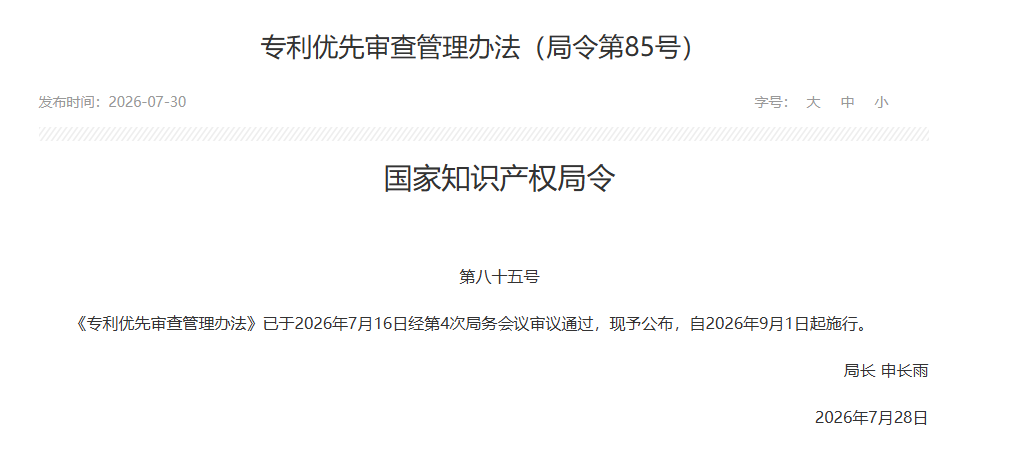
Only July 30, 2026, China’s National Intellectual Property Administration (CNIPA) released the revised Measures for Administration of Priority Examination of Patents (Order No. 85) (专利优先审查管理办法(局令第85号)) effective September 1, 2026. Unlike the United States Patent & Trademark Office’s (USPTO) prioritized examination system, foreigners do not appear eligible to use China’s priority examination system.
 Priority Examination is available for:
(i) Invention patent applications that are in the substantive examination stage and have not yet been given initial treatment. Initial treatment means that the examiner has begun examination and issued a notification.
(ii) Utility model and design patent applications;
(iii) Re-examination cases of invention, utility model and design patent applications (hereinafter referred to as re-examination cases);
(iv) Invalidation cases concerning invention, utility model and design patents (hereinafter referred to as invalidation cases).
For invention patent applications, the following conditions must be met:
(i) Involving emerging and future industries, or tackling key core technologies;
(ii) Industries that are key areas encouraged by the provincial or municipal people’s governments;
(iii) The patent applicant or the requester for re-examination has already industrialized the invention or has made preparations for industrialization, or there is evidence that others are implementing the invention;
(iv) A Chinese patent application for which a request for substantive examination has been filed in other countries or regions after the first Chinese patent application on the same subject matter has been filed.
(v) Other circumstances that are of great significance to national or public interests.
However, per Article 11, “the priority examination request form shall be accompanied by a recommendation from the relevant competent department of the State Council or the provincial intellectual property office” effectively preventing foreigners from requesting priority examination.
Some potential workarounds may include:
If priority examination is successfully requested, CNIPA will examine the invention application within 45 days of the granting of the request and complete examination within 1 year. Utility models and design patent applications will complete examination within 2 months.
A translation of the Measures follow. The original text is available here (Chinese only).
Chapter 1 General ProvisionsArticle 1 This Regulation is formulated in accordance with the relevant provisions of the Patent Law of the People’s Republic of China (hereinafter referred to as the Patent Law) and the Implementing Regulations of the Patent Law of the People’s Republic of China (hereinafter referred to as the Implementing Regulations of the Patent Law) in order to further promote the construction of a strong intellectual property nation and standardize the patent priority examination work.
Article 2 The patent priority examination work shall adhere to the leadership of the Party, uphold high-quality development, help optimize the business environment, support the development of new productive forces, and promote the construction of an innovative country.
Article 3 The CNIPA is responsible for the administration of priority examination of patents, accepting and reviewing requests for priority examination, strengthening the guarantee of examination resources, and improving the quality and efficiency of examination. Provincial-level intellectual property offices are responsible for recommending priority examination requests within their respective administrative regions.
The CNIPA may receive priority examination requests recommended by relevant departments under the State Council in accordance with these Measures.
Chapter Two: Applicable ConditionsArticle 4 This regulation applies to the priority examination of the following patent applications or cases:
(i) Invention patent applications that are in the substantive examination stage and have not yet been given initial treatment. Initial treatment means that the examiner has begun examination and issued a notification.
(ii) Utility model and design patent applications;
(iii) Re-examination cases of invention, utility model and design patent applications (hereinafter referred to as re-examination cases);
(iv) Invalidation cases concerning invention, utility model and design patents (hereinafter referred to as invalidation cases).
Priority examinations conducted in accordance with bilateral or multilateral agreements signed between the CNIPA and patent examination authorities of other countries or regions, or expedited examinations conducted after passing the preliminary examination by national-level intellectual property protection centers or rapid rights protection centers, shall be handled in accordance with relevant regulations and are not subject to this method.
Article 5 For patent applications and re-examination cases that have significant innovative value and promising prospects for commercialization, the patent applicant or re-examination requester may request priority examination if one of the following conditions is met:
(i) Involving emerging and future industries, or tackling key core technologies;
(ii) Industries that are key areas encouraged by the provincial or municipal people’s governments;
(iii) The patent applicant or the requester for re-examination has already industrialized the invention or has made preparations for industrialization, or there is evidence that others are implementing the invention;
(iv) A Chinese patent application for which a request for substantive examination has been filed in other countries or regions after the first Chinese patent application on the same subject matter has been filed.
(v) Other circumstances that are of great significance to national or public interests.
Article 6 In any of the following circumstances, the invalidation requester or the patentee may request priority examination:
(i) Where a patent infringement dispute has occurred and the parties have requested the local intellectual property office to handle the matter or filed a lawsuit with the people’s court;
(ii) Where a patent dispute has occurred, the parties have requested the CNIPA to conduct an administrative adjudication or mediation for major patent infringement disputes, an administrative adjudication for the early resolution mechanism of drug patent disputes, or to implement mediation for patent open licensing disputes;
(iii) A patent licensing contract dispute has arisen, and the parties have requested arbitration.
(iv) The patents involved are of great significance to national or public interests.
The local intellectual property office or people’s court specified in paragraph (i) of the preceding paragraph, and the arbitration institution specified in paragraph (iii) may request priority examination for invalidation declaration cases involving the patent in question.
Article 7 Patent agencies that provide services to patent applicants or parties to a case requesting priority examination shall maintain good credit, high business and service standards, and conscientiously fulfill their industry self-regulatory responsibilities.
Article 8 Patent applications or cases shall generally not be given priority examination if any of the following circumstances exist:
(i) The patent application is a divisional application, and the original application has been granted expedited examination;
(ii) An invention patent application in which the applicant applies for a utility model patent for the same invention on the same day;
(iii) Patent applications, re-examination cases, or invalidation cases have already been given priority examination or other forms of expedited examination within their respective examination procedures;
(iv) A patent application requesting priority examination pursuant to Article 5, Paragraph (iv) of these Measures has evidence indicating that it clearly has no prospect of being granted.
Chapter Three: Making a RequestArticle 9 Where there are two or more patent applicants, re-examination requesters, or patentees, when submitting a request for priority examination pursuant to Article 5 or Article 6, Paragraph 1 of these Measures, the consent of all applicants, all re-examination requesters, or all patentees shall be obtained.
Article 10 Patent applications or cases requesting priority examination shall be filed using electronic filing methods that meet the requirements.
Article 11 When an applicant requests priority examination for an invention, utility model, or design patent application, they shall submit a priority examination request form and materials related to the applicable circumstances stipulated in Article 5 of these Measures; except for the circumstances described in Article 5, Paragraph (iv) of these Measures, the priority examination request form shall be accompanied by a recommendation from the relevant competent department of the State Council or the provincial intellectual property office. Applicants may submit materials related to prior art or prior design information that may expedite the examination process.
When a party requests priority examination for a review case or an invalidation case, it shall submit a priority examination request form and materials related to the applicable circumstances stipulated in Article 5 or Article 6 of these Measures; the priority examination request form shall be signed with a recommendation from the relevant competent department of the State Council or the provincial intellectual property office.
When a local intellectual property office, people’s court, or arbitration institution requests priority examination for an invalidation case, it shall submit a request for priority examination and state the reasons.
Article 12 Except for the fees payable as stipulated in the Patent Law and its Implementing Regulations, the CNIPA shall not charge any additional fees for patent applications or cases requesting priority examination.
Chapter Four: Review and Examination ProceduresArticle 13 Provincial intellectual property offices shall recommend patent applications or cases requesting priority examination in accordance with the provisions of Articles 4 to 8 of these Measures, and explain the reasons for the recommendation; if the requester for priority examination submits false materials or engages in other acts that violate the principle of good faith, the application shall not be recommended.
Article 14 After accepting a priority examination request, the CNIPA shall review the priority examination request, the reasons for recommendation, and related materials in accordance with these Measures. If there are formal defects in the request materials, the priority examination requester shall be allowed to make modifications. After review, the CNIPA shall make an opinion on whether to grant priority examination and notify the priority examination requester of the review opinion.
Article 15 Patent applications or cases that the CNIPA agrees to conduct priority examination shall be processed within the following time limits from the date of issuance of the notice of priority examination, except in cases involving difficulties and complexities:
(i) An invention patent application shall be processed for the first time within forty-five days and closed within one year;
(ii) Utility model and design patent applications shall be concluded within two months;
(iii) Cases under review shall be concluded within seven months;
(iv) Invalidation cases of invention and utility model patents shall be concluded within five months, and invalidation cases of design patents shall be concluded within four months.
Article 16 For patent applications subject to priority examination, the applicant shall respond or make corrections as soon as possible. The time limit for the applicant to respond to the examination action notice for an invention patent application is one month from the date of issuance of the notice, and the time limit for the applicant to respond to the correction notice or examination action notice for a utility model or design patent application is fifteen days from the date of issuance of the notice.
Article 17 The CNIPA may terminate the priority examination procedure and process the application according to the ordinary procedure under any of the following circumstances, and shall promptly notify the priority examination requester:
(i) After the CNIPA sends a notice of priority examination, the applicant proposes amendments to the application documents in accordance with Articles 57(1) and (2) of the Implementing Regulations of the Patent Law;
(ii) The applicant’s response period exceeds the period stipulated in Article 16 of these Measures, or the applicant requests an extension of the response period;
(iii) The applicant submits false materials or engages in other acts that violate the principle of good faith.
Article 18 In the event of any of the following circumstances, the CNIPA may terminate the priority examination procedure and handle the case according to the ordinary procedure, and shall promptly notify the priority examination requester:
(i) The requester of the review requests an extension of the time limit for responding;
(ii) After the CNIPA sends a notice of priority examination, the invalidation requester supplements the evidence and reasons, or the patentee amends the claims in a manner other than deletion;
(iii) The patent re-examination or invalidation proceedings are suspended;
(iv) The trial of the case depends on the conclusions of the review of other cases;
(v) The party submits false materials or engages in other conduct that violates the principle of good faith.
Chapter Five Supervision and ManagementArticle 19 The CNIPA shall allocate and adjust the number of priority patent examinations in each region based on factors such as the management of priority examination work in each region, the recommendation and subsequent examination of priority examination requests, the progress of intellectual property protection and utilization, and the support for key national industries and major strategies. The CNIPA shall also determine the total number of priority patent examinations in a coordinated manner based on overall needs and examination capacity.
Article 20 Provincial-level intellectual property offices shall formulate rules for priority examination and recommendation, clarify recommendation standards, and ensure that the recommendation process is fair, just, open, and transparent, so as to strengthen the management and precise service of priority examination requesters.
Article 21 Staff members engaged in priority review, recommendation, review, examination, and management shall strictly abide by the relevant provisions of laws and regulations and shall not engage in dereliction of duty, abuse of power, favoritism, or other misconduct.
Article 22 For priority examination requesters or patent agencies that have violated the principle of good faith, the CNIPA shall not accept their priority examination requests within one year from the date the relevant conduct is determined.
Chapter Six Supplementary ProvisionsArticle 23 The CNIPA is responsible for interpreting these Measures.
Article 24 This regulation shall come into force on September 1, 2026. The “Administrative Measures for Patent Priority Examination” promulgated by Order No. 76 of the CNIPA on June 27, 2017, shall be repealed simultaneously.