Просмотр новости
Найдите то, что Вас интересует
 Спутники
 РН
РН SpaceX
 Роскосмос
 NASA
NASA
СпутникиРНSpaceXРоскосмосNASAThe Vancouver company that developed Sen̓áḵw’s district energy centre, Creative Energy, says this is likely North America's most efficient energy system and one of the first large-scale, net-zero housing projects in the world.
Article content
“So we partnered with them to bring that vision to life, and part of that was designing a zero-carbon energy system, which we’re looking at here, using the sewage heat recovery technology,” Wolfe said.
Article content
Creative Energy was previously Central Heat Distribution, which was a utility providing steam heat for buildings in downtown Vancouver.
Article content
In 2013, Westbank Corp. bought Central Heat for a reported $32 million, and it was rebranded the following year as Creative Energy. Today, Toronto-based private equity firm Instar is Creative Energy’s majority shareholder, and Westbank retains a minority stake.
Article content
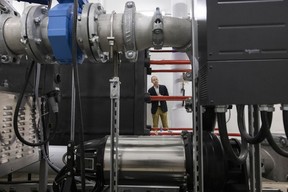 The Senakw development features a low-carbon energy system designed, built and operated by Creative Energy. Photo by Jason Payne /PNG
Article content
Creative Energy now specializes in developing district energy systems, which are centralized networks distributing thermal energy to several buildings. District energy systems are not new, as shown by Central Heat, which started in 1968, and university and hospital campuses have long used such systems. Now, companies like Creative Energy are tapping new resources for these facilities.
Article content
Creative Energy has 15 systems in B.C. and Ontario, with each “tailored” to its particular environment, Bate says.
Article content
Article content
Oakridge Park, which is not near a sewage main, uses hundreds of boreholes deep underground to harness the earth’s stable temperature to provide heating in the winter and cooling in the summer. Westbank’s huge waterfront development in Horseshoe Bay exchanges heat through pipes with a submerged heat exchanger on the ocean floor.
Article content
Each district energy system, Bate says, “is very much a bespoke approach that’s optimized for that specific application.”
Article content
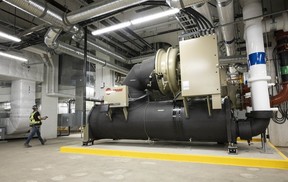 The Senakw development features a low-carbon energy system designed, built and operated by Creative Energy. Photo by Jason Payne /PNG
Article content
As cities grow and densify, civic leaders are thinking more about finding sustainable, reliable energy sources, said Brad Griffin, director of Simon Fraser University’s Canadian Energy and Emissions Data Centre.
Article content
“Lots of new ideas are coming around that we didn’t bother thinking about before, because natural gas was so cheap. Why would we bother to do anything else? Now they’re starting to think more creatively about what can we do,” Griffin said. “But it’s all sensitive to cost, just like anything.”
Article content
“Municipalities and developers are realizing (sewage heat recovery) is a resource we’ve been basically ignoring,” he said. “But it doesn’t always make sense. That big pipe needs to be relatively close to where the people are. … I think we can be more opportunistic, where we happen to want to add density for transit reasons or development reasons, and there’s a pipe there, then we’ll use it. But we typically can’t move one or the other to line up.”
Article content
Article content
To that end, Metro Vancouver’s regional planners are trying to get a sense of where those resources and opportunities might lie. Earlier this summer, the regional government issued a request for a consultant to undertake a “thermal energy networks opportunity analysis.”
Article content
Essentially, this will be a study to better understand where in the Metro region new and expanded district energy systems could be viable, in terms of existing energy sources (such as industrial heat, geothermal, and sewage heat recovery) and potential demand nearby, said Lise Townsend, division manager of air quality and climate action policy for Metro.
Article content
“This is a high-level regional scan and won’t involve designing specific systems — its purpose is to identify opportunities to support low-carbon energy solutions and reduce reliance on natural gas,” Townsend said, adding that B.C. Hydro and the Zero Emissions Innovation Centre are contributing funding to the study.
Article content
These kinds of energy networks offer several advantages, Townsend said, including better efficiency, more reliable and stable energy rates, reducing demand on the electricity system, and beneficially using energy that would otherwise be wasted.