Просмотр новости
Найдите то, что Вас интересует
 Спутники
 РН
РН SpaceX
 Роскосмос
 NASA
NASA
СпутникиРНSpaceXРоскосмосNASADressage trainer Aviva Nebesky explains whether you’ll be penalized for dropping your whip during a dressage test and when it’s acceptable change hands.
The post Ask the L: Proper Use of the Dressage Whip in the Show Ring appeared first on Dressage Today.
Q: Will a rider be marked down in any way if she intentionally or unintentionally drops her whip during a dressage test? And what is considered correct usage of the dressage whip in the show ring?
~ Terry
A: My short answer on whether you’ll be penalized for dropping your whip is no because you’re never required to ride with a whip during a test. If your show number accidentally falls off your bridle, you’re not penalized or eliminated. Riders sometimes get nervous and flustered and accidentally drop their whips. Other times, a rider might drop the whip if her horse gets overly anxious, reactive or spooky, which is the smart thing to do.
While I was watching a Grand Prix class during Dressage at Devon many years ago, I noticed a rider whose legs swung a lot during the tempi changes. During one of the tempis, he flung his legs so wildly that he pulled the stirrup leather and iron off the saddle.
He wasn’t eliminated—although maybe he should have been since you’re required to ride with both stirrups. But it certainly took away from the rest of his test because he was so unbalanced by having only one stirrup. Plus, it posed a safety risk if he’d accidentally ridden over the iron or leather. But with whips, this isn’t an issue.
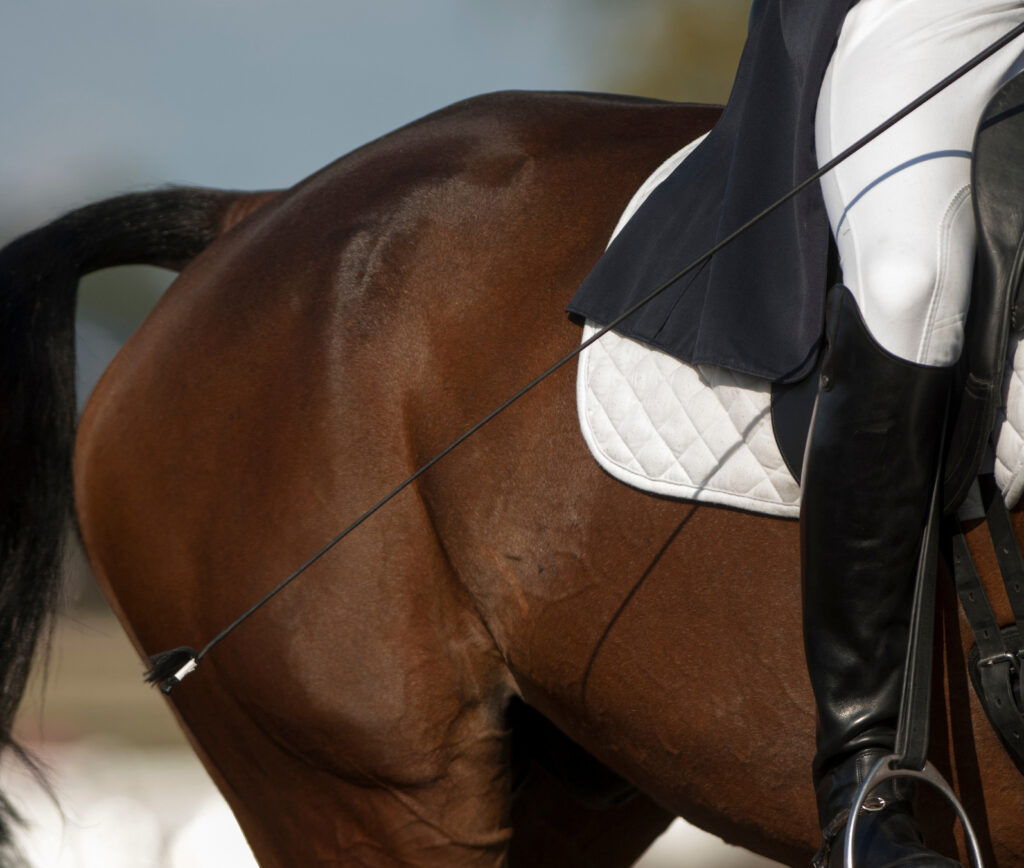 At the end of the day, the whip is a tool like your spurs. While you can’t pull your spurs off in the middle of your test, my point is: If your tool isn’t working, don’t use the tool. ©Amy K. Dragoo
The whip is not a required tool, and at the championship levels, you can’t carry one, so I can’t imagine that dropping it during a test would cause any issues with most judges. However, I would caution that if you deliberately drop your whip, do it subtly.
Don’t lift your arm up in the air and fling it out of the arena; simply move your hand to the side, open your fingers, drop it, and go right back to focusing on your test. If possible, try to drop it far enough off the track that you don’t risk riding over and breaking it. Also, remember where you dropped it so you can retrieve it after your test.
Changing Whip HandsStephany Fish Crossman, my cohost of the Dressage Today Podcast, brought up an interesting follow-up question. She asked how judges feel about riders switching their whip hand during the test. I’ve talked about this in the past a lot because it drives me crazy and is one of my ultimate pet peeves. If you don’t know how to switch your whip hand correctly, either learn to do it or don’t change hands. Pulling it up and waving it over your horse’s head will affect the quality of your contact.
To correctly change hands, gather both reins in the hand you’re currently holding your whip, lift and slightly angle the whip, grasp it with your free hand and draw it through while doing your best to maintain steady contact.
I see riders in the lower levels changing their whips every time they change directions—and often I never even see them use it. I don’t penalize them for this, but at the end of the test, I ask these riders if they really need a whip, and I usually get a deer-in-the-headlights’ look from them.
I also ask them if they really need to switch hands. Most horses tend to need the whip more on one side, so start with the whip on the side your horse needs it most and keep it there unless there’s a specific—and important—reason you need to change hands.
If, for example, your horse requires a little bit of encouragement in counter transitions, you might change your whip during the free walk when you’re not worried about losing the contact. Or, if you know how to change hands correctly and tactfully, it’s fine to do it as needed.
At the end of the day, the whip is a tool like your spurs. While you can’t pull your spurs off in the middle of your test, my point is: If your tool isn’t working, don’t use the tool.
For More:
Aviva Nebesky started riding in her 30s, but horses rapidly took over her life and she went on to graduate with distinction from the USDF “L” Program. She actively trains and competes in dressage while maintaining a busy teaching and judging schedule throughout the mid-Atlantic. She has her USDF Bronze Medal and the Fourth Level scores towards her Silver and has competed internationally representing the USA at the Maccabi Games in Israel in 2022.
Aviva regularly works with eventers, working equitation riders, Western Dressage riders and traditional dressage riders and also cohosts the Dressage Today Podcast with Stephany Fish Crossman. With a master’s degree in social services and Social Research and decades of work in the field of physical rehab, Aviva specializes in working with adult amateurs with fear issues.
| # | Наименование новости | Тональность | Информативность | Дата публикации |
|---|---|---|---|---|
| 1 | Ask the L: Key Differences Between Amateurs and Professionals | 0 | 7.36 | 15-07-2026 |
| 2 | Submit Your Dressage Photo for an Expert Critique | 0 | 6.01 | 21-07-2026 |
| 3 | How to Assess Progress in Your Dressage Training | 0 | 6.16 | 17-07-2026 |
| 4 | Changing Tack: Snaffles Only at Third Level | 0 | 9.97 | 13-07-2026 |
| 5 | Equestrian Sport Is Under Scrutiny. Can Science Save It? | 0 | 7.21 | 24-07-2026 |
| 6 | Don’t Get Tricked by Big Trots | 0 | 9.89 | 20-07-2026 |
| 7 | Arena Patterns to Develop a Better Partnership with Your Horse | 0 | 7.39 | 26-07-2026 |
| 8 | The Purpose and Value of Lateral Work | 0 | 7.31 | 10-07-2026 |
| 9 | ‘She Genuinely Wanted to Help People’: The Classic ‘Program Your Position’ Comes to Streaming | 0 | 8.09 | 22-07-2026 |
| 10 | Horrified barrel racers share horses' gruesome wounds after 'stalker' teen girl's barn stabbing spree...and reveal her bizarre behavior leading up to the attack | 0 | 7 | 01-06-2026 |