Просмотр новости
Найдите то, что Вас интересует
 Спутники
 РН
РН SpaceX
 Роскосмос
 NASA
NASA
СпутникиРНSpaceXРоскосмосNASAI use a wheelchair and yearn to dance like I did when I was a kid. Could I possibly hold my own in a class led by inspirational disabled dance star Kate Stanforth?From ballroom to hip-hop, I tried many different dance classes growing up, but nothing ever stuck for too long. My body never found its rhythm to any music, I quickly became exhausted from any physical exertion, and I concluded I must just not have been made for exercise.My theory was confirmed when I was 13 – and I was diagnosed with Friedreich’s ataxia (FA), which is a rare, progressive neuromuscular disease that causes nerve damage, muscle weakness and mobility loss. Now, aged 29, I use a wheelchair and a lot of my coordination has been eroded. I still love to dance but it’s increasingly rare I get the chance. Continue reading...
From ballroom to hip-hop, I tried many different dance classes growing up, but nothing ever stuck for too long. My body never found its rhythm to any music, I quickly became exhausted from any physical exertion, and I concluded I must just not have been made for exercise.
My theory was confirmed when I was 13 – and I was diagnosed with Friedreich’s ataxia (FA), which is a rare, progressive neuromuscular disease that causes nerve damage, muscle weakness and mobility loss. Now, aged 29, I use a wheelchair and a lot of my coordination has been eroded. I still love to dance but it’s increasingly rare I get the chance.
After reading an opinion piece in the Guardian three years ago by Kate Stanforth, a professional, wheelchair-using dancer, I followed her career on social media with delight and admiration. Having begun ballet at the age of two and entered pre-professional training at eight, Stanforth continued dancing for a short time after becoming unwell as a teenager. As her health needs became increasingly complex, she was eventually forced to stop training. She was diagnosed with ME, or myalgic encephalomyelitis, a chronic neurological condition that affects the body’s ability to produce and use energy, and later with Ehlers-Danlos syndrome, a genetic connective tissue disorder affecting the body’s collagen.
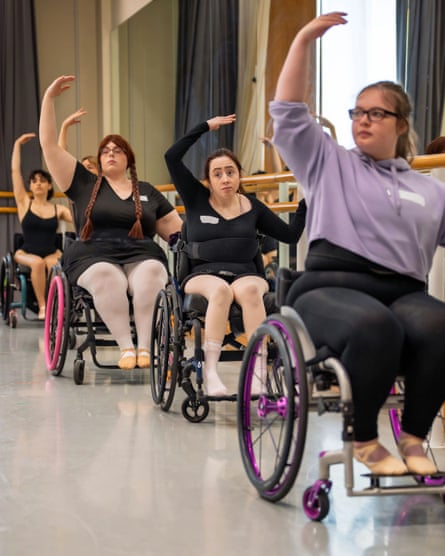
With her love for ballet and her lived experience of disability and chronic illness, Stanforth established the Kate Stanforth Academy of Arts, an award-winning inclusive arts organisation dedicated to accessible dance education. “Ballet was never simply a hobby to me,” said Stanforth. “It has always been a passion. Even when I became unwell at the age of 14, that passion never disappeared.”
When I read that she was hosting an adaptive ballet class in association with the Royal Ballet School, supported in part by Allied Mobility, I jumped at the chance to attend – even if it meant travelling from Dublin to London. Entering the Royal Ballet School, I was incredibly nervous. I felt like an impostor when I passed by a group of young girls in the hallways. I wondered if they questioned my presence.
Any nervousness I felt suddenly melted away when I entered the dance studio and saw a dozen wheelchair-using dancers spread out in a circle, doing warm-up exercises. The class started with some exercises at the barre, instructed by Stanforth and Rachael Hunt, international artistic manager at the Royal Ballet School. My movements were definitely not perfect, and I was a lot stiffer than the other dancers, but I felt that didn’t entirely matter. My abilities were accepted, and that meant everything to me.
Having all but turned my back on dancing almost two decades ago, it was cathartic to be able to do something I loved so much without all of the restrictive rules. Stanforth and Hunt made sure to repeatedly remind us to listen to our bodies, not to push our limits and, most importantly, to have fun.
We moved on to working on a dance repertoire from the ballet Giselle, a production I admit I haven’t seen on stage (yet). Giselle is a classic, romantic ballet from the 19th century, and one of the quintessential shows, like Swan Lake and The Nutcracker, that you might think of when you think of ballet productions.
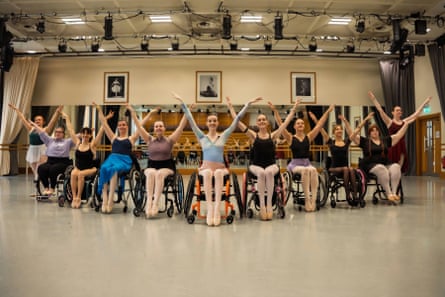
I watched the dancers with what I can only describe as awe. They practised crossing the room one-by-one with their arms gracefully extended, between synchronised pushes of their wheelchairs. As they glided past, they looked as if they were swimming through the air. It was truly beautiful. It seemed to me that stage productions of ballet are doing themselves a disservice by not opening up and allowing these fabulous wheelchair-using ballerinas to participate in their shows.
When the class ended, I definitely felt tired, but it was a satisfied tiredness, the total opposite of the frustrated exhaustion I often feel after trying to do an activity my body is physically unable to. Stanforth told us she was overwhelmed by the popularity of the class, with the morning and afternoon sessions selling out in a matter of minutes, and hundreds left on the waiting list. I wasn’t the only one who had travelled for the class – there were dancers from all over the UK, and somebody had even flown in from the Netherlands.
“This community is not small or rare – it has simply not always been visible,” said Stanforth, speaking about the worldwide network of 500 disabled dancers in the academy. Clearly, the interest for adaptive dance classes and workshops is there. “As that visibility grows, so does the possibility of a more open and inclusive future for ballet, where no dancer has to question whether they belong.”
It now seems entirely obvious that there is a place for disabled people in dance. The industry needs more people like Stanforth to work on making the world of dance accessible. When the class ended, I had a newfound sense of motivation to turn my adaptive ballet experience into a hobby. If a class like this existed closer to home, I’d be a regular attender.
For more information on the Royal Ballet School’s inclusive ballet classes with the Kate Stanforth Academy of Arts, click here