Просмотр новости
Найдите то, что Вас интересует
 Спутники
 РН
РН SpaceX
 Роскосмос
 NASA
NASA
СпутникиРНSpaceXРоскосмосNASAXiaomi India expanded its premium tablet lineup with its latest Xiaomi Pad 8, positioned as the successor to last year’s Xiaomi Pad 7. The new tablet brings a noticeable upgrade in display technology, performance, and productivity-focused features – clearly targeting users who want a powerful Android tablet for work, creativity, and entertainment without stepping into […]
Xiaomi India expanded its premium tablet lineup with its latest Xiaomi Pad 8, positioned as the successor to last year’s Xiaomi Pad 7. The new tablet brings a noticeable upgrade in display technology, performance, and productivity-focused features – clearly targeting users who want a powerful Android tablet for work, creativity, and entertainment without stepping into ultra-premium territory. The Xiaomi Pad 8 packs several features, including an 11.2-inch 3.2K 144 Hz display with Nano Texture Technology, the new Qualcomm Snapdragon 8s Gen 4 chipset, a large 9,200 mAh battery, and Dolby Atmos quad speakers. Xiaomi is also doubling down on productivity with HyperOS 3, PC-level features, and accessories like the Focus Pen Pro and keyboard options. After spending some time with the device, here’s what we think of it in our Xiaomi Pad 8 review.

The Xiaomi Pad 8 carries forward a refined and premium design language, very similar to its predecessor, but with subtle refinements that make it feel more polished in hand. It features an ultra-slim 5.75 mm full-metal unibody design, giving it a sleek, minimalist look while maintaining a solid and durable feel. The tablet is available in Titanium Blue and Graphite Grey, both offering a clean, professional aesthetic that fits equally well in work and entertainment environments. We got the Blue variant, as you can see in the images below.
On the front, the device is dominated by a large 11.2-inch 3.2K LCD display, and this remains one of its biggest highlights. The panel offers a sharp resolution (3,200 × 2,136 pixels) with a high 345 ppi pixel density, 3:2 aspect ratio, and a smooth 144 Hz adaptive refresh rate, making everything from scrolling to multitasking feel fluid and responsive. Xiaomi has also pushed touch responsiveness further with up to 360 Hz touch sampling rate (1080 Hz instantaneous) and 240 Hz stylus sampling, which enhances both everyday interactions and precision tasks like drawing or note-taking.
The display is capable of reaching 800 nits peak brightness (600 nits typical), making it bright enough for indoor use and reasonably usable outdoors. It also supports 12-bit color depth (68.7 billion colors), delivering richer gradients and more natural color transitions, especially noticeable while watching HDR content.
Features like HDR10, Dolby Vision, TÜV Rheinland Low Blue Light certifications, DC dimming with 4,096 brightness levels, Sunlight mode, and Reading mode further improve visual quality while ensuring better eye comfort during long usage sessions. It also uses the Wet Touch technology, which means the touchscreen responds even with wet hands.
The best thing about the screen is that it uses the Nano Texture Display technology, which introduces anti-glare and anti-reflective properties, reducing reflections significantly and improving visibility in bright environments. This makes a noticeable difference compared to regular glossy panels, especially for outdoor usage or under harsh lighting.
Complementing the display is a quad-speaker setup with Dolby Atmos, delivering loud, clear audio with good stereo separation – particularly in landscape mode. Combined with the large, high-resolution screen, the multimedia experience feels immersive and well-balanced for movies, music, and gaming.
Accessories like the Focus Pen Pro and keyboard integrate seamlessly, transforming the tablet into a more versatile workstation when needed. The Focus Pen sticks to the top, while the tablet firmly holds the study keyboard with a tight hinge, giving a great tablet experience.
In terms of layout, you get a familiar design – USB Type-C port, quad speakers (two on each side), and multiple microphones for better audio capture. The magnetic attachment for the stylus and keyboard connector pins further reinforce its productivity-focused approach.
Overall, the Xiaomi Pad 8 delivers a premium design, high-quality display, and solid build, making it one of the most well-rounded tablets in its segment for both entertainment and productivity use.
Software, User Interface, & FeaturesThe Xiaomi Pad 8 runs on Xiaomi HyperOS 3 based on Android 16, and this is where the tablet truly starts to feel like a next-generation productivity device rather than just a large-screen Android slate. Xiaomi has clearly focused on refining the overall experience – making it smoother, smarter, and better optimized for a tablet form factor.


In everyday usage, HyperOS 3 feels fluid, responsive, and well-optimized for the 11.2-inch display. Animations are smooth, app transitions are quick, and the UI scales nicely across different use cases – whether you’re using it with touch, a keyboard, or a stylus. Multitasking features like split view (5:5), flexible window ratios (1:9), and floating windows work seamlessly, making it easy to handle multiple apps at once without slowdowns.
One of the biggest highlights this time is Xiaomi’s push towards AI-powered features under “HyperAI”, which adds real-world utility beyond just performance. Features include:
These features make the tablet more useful for students, professionals, and creators, especially in scenarios like note-taking, content writing, online meetings, and research.
Xiaomi has also enhanced the Workstation Mode, which transforms the UI into a more desktop-like interface with an improved dock for quick access to apps. Paired with the PC-level browser, which supports features like mouse hover previews, right-click functionality, and enhanced controls, the tablet starts to feel closer to a lightweight laptop replacement for many tasks.
For productivity, built-in support for WPS Office (Docs, Sheets, Slides, PDFs) ensures you can handle most office-related work without needing third-party apps. Combined with accessories like the Focus Pen Pro and keyboard, the overall experience becomes much more versatile. Another strong area is ecosystem integration, especially if you’re using other Xiaomi devices. Features like seamless connectivity, shared workflows, and cross-device functionality make the Pad 8 feel like a natural extension of your smartphone or laptop.
Xiaomi Focus Pen Pro (Stylus Experience)The Xiaomi Pad 8 is compatible with the Xiaomi Focus Pen Pro, and this is easily one of the most advanced stylus implementations in this segment. It features a sleek, buttonless design with a balanced 17.5 grams weight, making it comfortable for long writing or sketching sessions. The pen supports an impressive 16,384 levels of pressure sensitivity and a 240 Hz touch sampling rate, delivering precise input with ultra-low latency.
What really sets it apart is its gesture-based interaction system with haptic feedback, replacing traditional buttons for a more intuitive experience. You can perform actions like gentle pinch, double press, slide gestures, and even pen rotation to control tools, adjust brush thickness, or switch between functions. Features like hover preview allow you to see the exact pen position before touching the screen, improving accuracy, especially for creators.
The stylus also integrates deeply with Xiaomi’s ecosystem, supporting features like “write with screen off” to instantly launch notes, and broad compatibility with third-party apps for drawing and annotation. Combined with its magnetic attachment, flexible nib, and long battery life, the Focus Pen Pro transforms the Pad 8 into a powerful digital canvas for students, artists, and professionals.
Xiaomi Focus Keyboard (Productivity Experience)The Xiaomi Pad 8 is complemented by the Xiaomi Focus Keyboard, designed to deliver a true laptop-like experience. It features a floating design with a high-precision metal hinge and supports 0° to 124° stepless angle adjustment, allowing you to comfortably use it in different scenarios – whether on a desk, lap, or while traveling.
The keyboard offers a PC-level typing experience, with large keycaps, optimal spacing, and 1.3mm key travel, ensuring comfortable and accurate typing even during long sessions. It also includes adaptive backlighting, which automatically adjusts based on ambient lighting conditions for better visibility.
A major highlight is the full-size mechanical trackpad, which supports a wide range of gestures like three-finger navigation, app switching, screenshots, and multitasking controls – bringing it closer to a traditional laptop workflow. The trackpad uses a premium surface for smooth gliding and includes accidental touch protection for better usability. The Xiaomi Pad 8 Keyboard is available as an alternative without a trackpad.
Connectivity is seamless thanks to the magnetic pogo pin connection, enabling instant pairing with minimal latency. The keyboard also supports smart wake and sleep functionality, automatically waking the tablet when opened and putting it to sleep when closed.
Hardware, Performance, & GamingThe Xiaomi Pad 8 takes a significant leap in performance, positioning itself much closer to flagship-level tablets rather than mid-range offerings. Powering the device is the 4nm Qualcomm Snapdragon 8s Gen 4 octa-core SoC, which is a major upgrade over previous generations (Snapdragon 7+ Gen 3 on Pad 7) and is designed to deliver both high-end performance and better efficiency.
Powered by Faster Snapdragon 8s Gen 4The chipset features a powerful octa-core configuration (1 + 3 + 2 + 2):
Handling graphics is the Adreno 825 GPU (~1.15 GHz), which brings noticeable improvements in rendering performance, smoother UI animations, and better sustained gaming output. Paired with up to 12 GB LPDDR5T RAM (9,600 Mbps) and up to 256 GB UFS 4.1 storage, the tablet benefits from faster memory bandwidth and significantly quicker read/write speeds – resulting in faster app launches, seamless multitasking, and smoother overall responsiveness.
Do note that the base variant, i.e., with 8 GB RAM and 128 GB Storage, comes with a slightly lower speed LPDDR5X (8,533 Mbps) and a lower-end UFS 3.1 storage type; although fast enough, the top-end model makes more sense if you want the best performance.


In real-world usage, the Pad 8 feels fast, fluid, and consistently responsive. Whether it’s heavy multitasking, split-screen workflows, document editing, or running multiple apps simultaneously, the tablet handles everything effortlessly. The combination of a powerful chipset and optimized HyperOS 3 ensures that performance remains stable even under sustained workloads.
Multitasking, in particular, is where the device shines. Features like split view, floating windows, and workstation mode work smoothly without noticeable lag, making it a strong productivity companion. The large 11.2-inch display further enhances this experience, allowing comfortable side-by-side app usage for work and study.
When it comes to gaming, the Xiaomi Pad 8 delivers a near-flagship gaming experience. Popular titles like BGMI, Call of Duty: Mobile, Asphalt 9, and even demanding games like Genshin Impact run smoothly at high to very high graphics settings with stable frame rates. Most games run in high graphics settings, so gaming is wise here. You will also benefit from the nano-texture screen + loud stereo speakers, making the gaming as well as multimedia experience exceptional. The Adreno 825 GPU ensures better visual fidelity, while the high refresh rate display adds to the smoothness during gameplay.
Thermal performance is also well-managed, with the device maintaining stable performance during extended gaming sessions and heavy usage without excessive heating. Combined with its large battery, the tablet is well-suited for long gaming sessions without frequent interruptions.
Overall, the Xiaomi Pad 8 offers powerful hardware, flagship-grade performance, and excellent gaming capabilities, making it one of the most capable Android tablets in its price segment.


The Xiaomi Pad 8 keeps things simple and functional on the camera front, which is exactly what you’d expect from a tablet focused on productivity and entertainment rather than photography. It features a 13 MP rear camera with dual LED flash and an 8 MP front-facing camera, covering all the essential use cases without overcomplicating the setup.
In real-world usage, the rear camera performs well in good lighting conditions, capturing images with decent detail and natural colors. It’s best suited for practical tasks like scanning documents, capturing notes, whiteboards, or presentation slides, and occasional casual photography. As expected, low-light performance is fairly basic, but for everyday tablet use, the camera does its job reliably. The 8 MP sensor delivers clear and usable video quality for video calls, online classes, and meetings in well-lit environments.
Xiaomi also includes a range of useful camera modes, such as Document mode for scanning, Portrait mode, HDR, and standard video features, keeping the interface clean and easy to use. Some features include Pro Mode, Beauty Mode, Teleprompter, Video Filters, Video Beauty, Voice Control Shutter, Gesture Shutter, Fill Light, and more. While it’s not built for serious photography, the Pad 8 offers a practical and well-balanced camera experience that aligns perfectly with its overall purpose.


The Xiaomi Pad 8 packs a 9,200 mAh dual-cell high-energy-density battery, offering a noticeable upgrade over its predecessor (8,850 mAh) while maintaining a slim form factor. Xiaomi continues to use its dual-cell architecture, which helps improve charging efficiency and overall battery longevity, making it well-suited for both heavy workloads and extended media consumption.
In day-to-day usage, the tablet easily delivers all-day battery life for most users. The Pad 8 holds up comfortably without frequent charging, no wonder if you are streaming videos, attending meetings, multitasking with split-screen apps, or casual gaming. Xiaomi claims up to 9+ hours of video playback, and in real-world usage, it performs consistently for productivity, entertainment, and mixed usage scenarios.
Charging is handled via 45W fast charging, and interestingly, Xiaomi bundles a 67W charger in the box, which helps maximize charging speeds and can be used for other devices as well. Thanks to the dual-cell setup, the tablet charges relatively quickly, generally achieving a 0 – 100% charge in approximately ~90 minutes.
Another useful addition is 22.5W wired reverse charging, allowing the tablet to act as a power source for other devices like smartphones, earbuds, or accessories. This adds an extra layer of convenience, especially during travel or when you’re away from a charger. The Pad 8 also supports a wide range of fast-charging protocols, including QC3+, PD3.0, and Xiaomi’s own fast charging standards, ensuring compatibility across different chargers and accessories.

The Xiaomi Pad 8 comes across as a refined and meaningful upgrade that pushes Xiaomi’s tablet lineup closer to the flagship category, without going all the way into ultra-premium pricing. Instead of chasing gimmicks, Xiaomi has focused on core user experience – display quality, performance, software, and productivity – and it shows in everyday use.
The 11.2-inch 3.2K 144 Hz display with Nano Texture option continues to be one of its biggest strengths, offering a sharp, smooth, and comfortable viewing experience, especially in brighter environments. Paired with Dolby Atmos quad speakers, the tablet delivers an immersive multimedia setup that’s easily among the best in its segment.
Performance is another major highlight. The Snapdragon 8s Gen 4 chipset, combined with LPDDR5T RAM and UFS 4.1 storage, ensures flagship-grade responsiveness, whether you’re multitasking, working on productivity apps, or playing demanding games. It’s a noticeable step up from typical mid-range tablets and feels future-ready for long-term use. Battery life is dependable, with the 9,200 mAh battery easily lasting a full day, while fast charging and reverse charging add to its practicality.
On the software side, HyperOS 3 with AI-powered features (HyperAI) adds actual utility rather than just surface-level enhancements. Features like AI Writing, Live Subtitles, and workstation-style multitasking make the Pad 8 a capable productivity device, especially when paired with the Focus Pen Pro and Focus Keyboard, which together transform it into a near laptop-like setup.
Overall, the Xiaomi Pad 8 strikes a strong balance between performance, display quality, and productivity features. It’s an excellent choice for users who want a premium Android tablet for work, entertainment, and gaming, without stepping into the highest price tiers. If you’re looking for a powerful, future-ready tablet that can double as a productivity machine, the Pad 8 is easily one of the most compelling options in 2026.


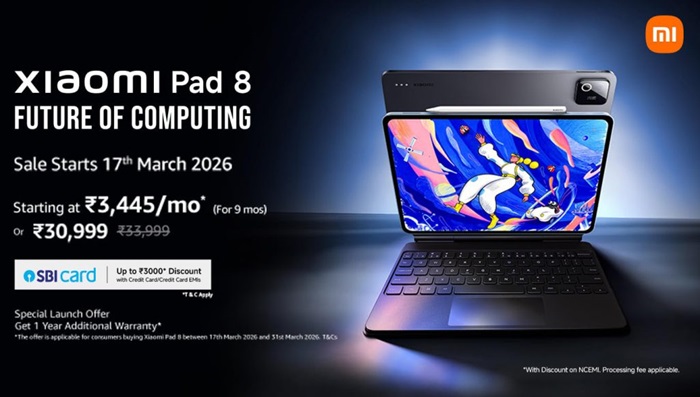
The Xiaomi Pad 8 is priced at ₹33,999 for its 8 GB RAM + 128 GB Storage variant, ₹36,999 for its 12 GB RAM + 256 GB Storage variant, and ₹38,999 for its 12 GB RAM + 256 GB Storage with Nano Texture Display. The accessories include Xiaomi Focus Pen Pro priced at ₹5,999, Xiaomi Pad 8 Keyboard priced at ₹4,999, and Xiaomi Pad 8 Focus Keyboard priced at ₹8,999. The tablet is available on Amazon.in, Mi.com/in, Xiaomi retail stores, and other offline outlets. The launch offers include up to ₹3,000 discount with SBI credit cards, no-cost EMI up to 9 months, ₹1,000 off on Xiaomi Focus Pen Pro with the Creator’s Edition bundle, ₹1,000 discount when purchasing the tablet with the stylus and keyboard, and 1-year additional warranty for purchases made until 31st March 2026.
Get Xiaomi Focus Pen Pro on Mi.com/in
| # | Наименование новости | Тональность | Информативность | Дата публикации |
|---|---|---|---|---|
| 1 | Xiaomi Pad 8 debuts in India with 11.2-inch Nano Texture display, 9200mAh battery, Snapdragon 8s Gen 4, HyperOS 3, and more | 0 | 15.93 | 11-03-2026 |
| 2 | REDMI Pad 2 Pro 5G Review – Strong Performance Meets Massive Battery | 0 | 17.67 | 12-01-2026 |
| 3 | Xiaomi Pad 8 and Xiaomi Pad 8 Pro debut globally at MWC 2026 alongside Xiaomi 17 Series | 0 | 15.87 | 01-03-2026 |
| 4 | REDMI Pad 2 Pro 5G – Hands-On and First Impressions | 0 | 17.78 | 07-01-2026 |
| 5 | Xiaomi Pad 8 review: ‘Mobile workstation’ gets a speed boost | 0 | 10.13 | 10-03-2026 |
| 6 | REDMI Pad 2 Pro 5G launched in India starting at ₹24,999 featuring 12.1-inch display, 12000mAh battery, 5G-ready, Snapdragon 7s Gen 4, and more | 0 | 15.92 | 06-01-2026 |
| 7 | Im Test: Xiaomi Pad 8 Pro | 0 | 10.39 | 19-06-2026 |
| 8 | Xiaomi Pad 8 Pro – affordable Snapdragon 8 Elite tablet? | 0 | 11.19 | 13-03-2026 |
| 9 | Xiaomi 17T Review – Leica Telephoto Excellence | 0 | 17.44 | 04-06-2026 |
| 10 | REDMI Note 15 SE 5G Review – Slimmer Design, Stylish Curved AMOLED | 0 | 13.04 | 23-05-2026 |