Просмотр новости
Найдите то, что Вас интересует
 Спутники
 РН
РН SpaceX
 Роскосмос
 NASA
NASA
СпутникиРНSpaceXРоскосмосNASALockheed Martin‘s [LMT] Skunk Works division plans to fly a Vectis drone prototype by the end of next year and to build another four aircraft to accelerate development and the […]
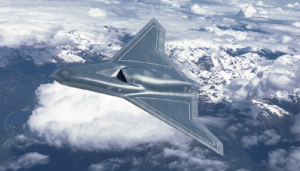 Pictured is a Lockheed Martin Skunk Works depiction of a future Vectis drone.
 Lockheed Martin‘s [LMT] Skunk Works division plans to fly a Vectis drone prototype by the end of next year and to build another four aircraft to accelerate development and the demonstration of the drone for air-to-air and other missions.
Vectis “is designed to employ a variety of air-to-air, air-to-ground and ISR payloads to accomplish a range” of military missions, the company said.
Last September, Skunk Works said that it considers Vectis a good candidate for Increment 2 of the U.S. Air Force’s Collaborative Combat Aircraft (CCA) program (Defense Daily, Sept. 21, 2025).
A large, runway dependent drone, Vectis is to be in the Group 5 class of unmanned aircraft systems. The name of Vectis stems from the Latin word for “lever.”
In June, the Air Force chose the FQ-42A Dark Merlin by General Atomics Aeronautical Systems, Inc. (GA-ASI) and the FQ-44A Fury by Anduril Industries. to enter engineering and manufacturing development for Increment 1 of CCA (Defense Daily, June 17).
Vectis is to be 34 feet in length–two feet shorter than GA-ASI’s MQ-9A Reaper–and to have a maximum gross takeoff weight of 12,500 pounds. The Williams International FJ44 is to power the Vectis prototype. The FQ-44A also uses that engine, which has about 4,000 pounds of thrust.
The “submerged,” center-line inlet design on the top of Vectis “has a long heritage for us,” Ron “Epic” Fehlen, Skunk Works vice president and general manager, told reporters last week. “There’s a lot of different reasons behind it. The first is it reduces frontal drag on the aircraft. If you want better performance and better range, you need to be able to reduce that drag. As the Air Force speaks about Agile Combat Employment, there is an advantage to having an inlet on the top of the aircraft, if you’re out in austere environments and concerned about fog pick-up off of a runway.”
The Skunk Works-developed P-175 Polecat had a similar inlet design. The Polecat prototype crashed in 2006.
The Vectis drone design lacks hard points for external weapons–a factor to add more stealth. The lack of a tail also is to increase the drone’s range.
“We’re really getting after a survivable platform that is multi-role in nature,” Fehlen said. “There’s a lot of missions that these types of systems could be applied to. We’re very cognizant of that as we design it and produce the first prototype.”
The Air Force aims for a maximum unit cost of $20 million per CCA (Defense Daily, Sept. 3).
“We’re always looking at affordability, and we’re targeting to be a CCA competitive price and make trades associated with that,” Fehlen said.
| # | Наименование новости | Тональность | Информативность | Дата публикации |
|---|---|---|---|---|
| 1 | Pentagon Program Selects 17 Companies To Compete In Drone Bomber Qualifier | 0 | 25.58 | 22-09-2026 |
| 2 | Drone Mothership Developer Modalic Gives Peek At First Production Aircraft | 0 | 23.98 | 18-09-2026 |
| 3 | Lockheed Martin Demonstrates Airspace Awareness System For Drones With Commercial Partners | 0 | 21.77 | 12-08-2026 |
| 4 | Navy Seeks New Affordable Interceptor In Request For White Papers | 0 | 18.48 | 18-09-2026 |
| 5 | Department of the Air Force Focused on Mission Systems for Future Tanker to Succeed KC-46 and KC-135 | 0 | 14.76 | 21-09-2026 |
| 6 | Pentagon and Lockheed Martin Enter Agreement to Accelerate JATM Production | 0 | 21.62 | 17-09-2026 |
| 7 | Army Details New Next-Gen C-sUAS Missile Effort, Aims For Unit Cost Below $150,000 | 0 | 29 | 05-08-2026 |
| 8 | Air Force Looking For Drone Production In Remote, Forward Locations | 0 | 21.74 | 07-08-2026 |
| 9 | Пентагон приближается к созданию роя ИИ-ведомых боевых дронов для истребителей F-35 | 0 | 16.53 | 30-07-2026 |