Просмотр новости
Найдите то, что Вас интересует
 Спутники
 РН
РН SpaceX
 Роскосмос
 NASA
NASA
СпутникиРНSpaceXРоскосмосNASAAnyone who’s actually played “elbows-up” hockey knows an effective offence makes the best defence
 Canadian Prime Minister Mark Carney speaks about the trade dispute with the United States at the Davie Shipyard in Levis, Quebec, Canada on August 24, 2026 Photo by Andrej Ivanov /Getty
Congratulations, Prime Minister, you grew some. Notice the lack of “finally” in that commendation. I have to confess that I wrote two leads to this column Friday night before hitting the sack, and the other, as you might well imagine, wasn’t nearly as complimentary. I suspect that pretty much every Canadian who went to bed before Trump’s midnight deadline had pretty much the same doubts.
Nonetheless, no “finally.” We’ll stick to how difficult a decision pulling out of negotiations must have been, and how forthright (and this time I will add a “finally”) you were in your condemnation of the last-minute changes — yeah, Howard Lutnick — that pushed us too far. Again, judging from recent polls — and the truly heinous nature of the “DEAL” proffered — I suspect most Canadians are now in your corner.
That all said, it appears we’re now “officially” at war. The first thing we need, of course, is a strategy. A determination of where the enemy is weakest, how that weakness might be best exploited, and, most of all, because we (unfortunately) live in a totally connected world, we need messaging. Please allow me to some suggestions for the automotive industry.
Hopefully, everyone knows — or, at least, I hope everyone reading this column knows — that Trump has reserved the highest of his auto-related tariffs for heavy-duty trucks. That’s because both General Motors and Ford produce heavy-duty trucks in their Canadian (Oshawa and Oakville, respectively) assembly plants. Actually, it would be more accurate to say that The General is producing both heavy-duty and 1500 versions of the Silverado in Oshawa; while Ford is promising to build Super Dutys in Oakville, but has yet to do so. Semantics aside, Trump wants to kill GM’s Oshawa production and nip Ford’s plans in the bud. Basically, he is trying to use one specific pinpoint tariff to eradicate the vehicles that both GM and Ford are making — or hoping to make — in Canada. Yes, he’s a prick.
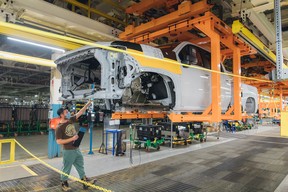 A separated truck cab and bed move through an assembly line at General Motors’ Oshawa assembly plant as employees work below Photo by Ryan Bolton /General Motors
The obvious response would be to also tariff this segment. That way, if GM — or Ford — took its heavy-duty truck production south, said trucks would face a, well, heavy duty coming into Canada from wherever they would be built in the U.S. This, I believe, would fall in the category of “proportional” response, and would actually be surprisingly hurtful since heavy-duty trucks sell in much larger numbers than most would suspect. Certainly, more than I suspected. Nonetheless, as an Anglo who grew up in the Northern Quebec bush-hockey fraternity, I can tell you that proportional responses do not, as a general rule, deter the determined ass-hat. And, Donald Trump is nothing if not determined.
If we, as a nation, want to congratulate ourselves on how we’ve managed to remain civilized in the face of brutishness, then this might be the way to go. If we actually want to get Donald’s attention, though, I think it’s a flop.
Tariff remission is a subject much discussed these days, not the least in Motor Mouth columns. For those just getting up to speed on our now officially-declared trade war, in response to 25% tariffs previously implemented by Mr. Trump on Canadian-built vehicles being exported to the States, Canada imposed a similar 25% tariff on American cars coming across our border. Meanwhile, to reward the five automakers who actually build cars in Canada — Honda, Toyota, General Motors, Stellantis, and Ford — we granted them remission, basically making them “good” on the duties they would have otherwise have been forced to pay. In return, they promised to keep building cars in Canada.
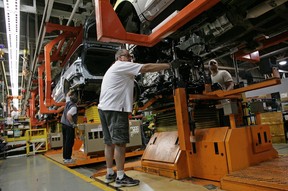 Ford employees work on the line at an assembly facility in Oakville, Canada Photo by Getty
It’s a good system in theory. Unfortunately, the Liberals’ — sorry, guys, even though I’m trying to be helpful here, I gotta call a spade a spade — implementation of said remission program leaves much to be desired. First off, they granted Ford free rein to bring cars into Canada tariff-free on the promise to, again, produce vehicles in Oakville sometime in the future. However, Ford has not produced a car in Canada for almost two-and-a-half years, and yet it got the same deal as Honda and Toyota, which, between them, build around 900,000 cars here in the Great White Frozen North.
A much better solution would be to implement a Canada-U.S.-Auto-Pact-era one-to-one ratio between car production and tariff credit. For every car you build here, you get one credit. You can either apply it as a “get out of jail free” card when you import cars from the United States; or you could sell extra, unneeded credits to automakers with no production facilities in Canada looking to import a vehicle from one of their U.S. production facilities.
Toyota and Honda, whom I think we all agree should be rewarded for building almost 80% of the vehicles produced in Canada, would have on the order of hundreds of thousands of credits to sell, and thus would be even further incentivized to keep their facilities in Aliston, Woodstock, and Cambridge running at full blast. Automakers without production facilities here in Canada would also benefit. My back-of-the-napkin calculations suggest that both Japanese giants have more than enough spare credits to accommodate all those non-producers — Nissan, Hyundai, Volvo, and others — who have cars built in the U.S. that they haven’t been bringing into Canada.
Actually, with Toyota and Honda building so many cars here, the market price for credits would probably be a fraction of the cost of the comparable actual tariff cost. And, if you think that Toyota and Honda making out like bandits in the credit market isn’t fair, whom do you really want to reward, two Japanese companies who haven’t laid off a single full-time worker since they came to Canada; or their American compatriots who’ve been gradually pulling out of Canada for more than two decades now?
 U.S. President Donald Trump speaks with Canadian Prime Minister Mark Carney at a working lunch with leaders of G7 and the Middle East, on June 16, 2026 in Evian-les-Bains, France Photo by Evelyn Hockstein /Getty
In the end, I think we need something a little more Machiavellian. Something a little more out of left field. For one thing, it might be better if retaliation — at least auto-industry-related retaliation — were time-delayed so it could match the imposition of Trump’s latest 50% tariffs, set to hit our auto segment come January 1, 2027. For another, it would squeeze the Americans where they’re weakest. As un-Canadian as that may seem — remember, we’re the polite ones — the best way to win a “war” is to exploit the enemy’s exposed flank.
For the American auto industry, I’m talking about trucks. The most important thing our negotiators need to realize is that Canada is, by quite some margin, the largest export market the Detroit Three have for full-sized pickups. Not just in North America, but anywhere in the world. By my rough estimation, we Canadians buy about 15% of all the big pickups that Detroit produces. No one else comes close. For, instance, Ford sells about 11,500 F-Series a month in Canada, which means we buy nearly as many F-150s and Super Dutys every 30 days as Mexicans do in a year, and at least five times more than the Australians do in a month. We really are that important to GM, Ford, and Stellantis.
Which means that’s exactly where we should hit them. Here’s the plan: the program by which Ford, GM, and Stellantis are granted remission runs out on April 8, 2027. What if, to counter Trump’s January 1 tariffs, on April 9, we announce that we will start charging full tariffs on all full-sized trucks and, instead of giving them blanket remission no matter how many — or few — vehicles they build in Canada, we implement that one-for-one credit system I mentioned, granting remission only on the number of cars automakers actually manufactured in Canada?
A much better solution would be to implement a Canada-U.S.-Auto-Pact-era one-to-one ratio between car production and tariff credit—for every car you build here, you get one credit
While all three would be impacted — GM would face a modest deficit, and Stellantis might actually come out a little ahead of the game — Ford would be hard hit. As I pointed out earlier, the company’s enjoying tariff remissions right now based only on the promise of future production. So, instead of being able to import some 130,000-plus F-Series trucks tariff-free — as it did last year — without producing a single car here, every full-sized pickup from F-150 all the way to F-450 would be subject to the full tariff regime without remission.
Were we to simply continue at the existing tariff rate of 25%, Ford, if it still hadn’t started production by next April, would be on the hook for about $70 million a month, give or take a mil or two, once you factor every little bit of Canadian parts and materials. Even in the world of global automakers, that’s serious moolah, and, again, I’ll remind you, $70 million more than the company has been paying despite not building any cars here.
Now for the tactical part: don’t keep the money. Or at least, promise to pay it back if — let’s hope “when” — the Oakville plant starts pumping out those long-promised work-a-day trucks, or, now that Trump is specifically tariffing those, some other vehicle. In fact, don’t put those untold millions, as you usually might, in your public ledger. Instead, create an all-new account specially labelled something like “Auto Industry Remittable Duties.”
 Canadian Prime Minister Mark Carney speaks about the trade dispute with the United States at the Davie Shipyard in Levis, Quebec, Canada on August 24, 2026 Photo by Andrej Ivanov /Getty
That would kill two birds with one stone. Firstly, because of its conditional nature, it might not, in the eyes of some, be strictly considered a retaliatory tariff — you, know the ones that U.S. Trade Representative Jamieson Greer is so vehemently warning us against implementing — because all the monies would be repaid once a final agreement comes to fruition and, of course, Ford makes good on its promise to re-open Oakville.
More importantly, it might give Canada the marketable message it will need to take the fight to the American public. Trump will no doubt soon plague Truth Social with his all-caps derision of ‘venal’ Canadians. Why not respond with an ad campaign pointing to a bank balance obviously held in escrow to be returned to said automakers on the fulfillment of their agreed-upon obligations? It’d be a powerful counter-message. It’d probably cause more ruckus than Doug Ford’s “Ronald Reagan” ads. Hell, if we promised to pay back those fines “with interest,” I suspect that more Americans might look more favourably upon our government than their own.
Announcing such an action would also provide warning to everyone that Canada is playing hardball. Perhaps, if we had gone on offence earlier, Stellantis might not have abandoned its Brampton plant quite so easily. Even better, messaged well, it would show, again to that all-important American public, that even when attacked with provocation, Canadians fight fair.
I get that this is would be entering (tariff) territories uncharted. And that the reaction from the America administration will be strong and swift, not to mention harsh. But, if not now, when? Indeed, for all its immorality and blood-thirst, the Iran regime has taught us one incontrovertible absolute: defeating Trump simply requires withstanding his threats longer than he’s willing to impose them. In other words, now that you’ve grown those cajones, Mark, use ’em.
Oh, and P.S., Mr. Prime Minister: you’re absolutely right. Donald Trump doesn’t need Howard Lutnick to be stupid. He’s perfectly capable of that all on his own.
Sign up for our newsletter Blind-Spot Monitor and follow our social channels on X, Tiktok and LinkedIn to stay up to date on the latest automotive news, reviews, car culture, and vehicle shopping advice.
 David Booth
David Booth is Driving’s senior writer as well as the producer of Driving.ca’s Driving into the Future panels and Motor Mouth podcasts. Having written about everything from the exact benefits of Diamond Like Coating (DLC) on motorcycle camshafts to why Range Rovers are the best vehicles for those suffering from opioid-induced constipation, Booth leaves no stone unturned in his quest for automotive veritas. Besides his long tenure with Driving, he was the editor in chief of Autovision magazine for 25 years and his stories have been published in motorcycle magazines around the world including the United States, England, Germany and Australia.
EducationGraduating from Queen Elizabeth High School in 1973, Booth moved from his Northern Quebec hometown of Sept-Iles — also home to Montreal Canadiens great, Guy Carbonneau — to Ottawa to study Mechanical Engineering at Carleton University. There, he wrote a thesis on the then-burgeoning technology of anti-lock brakes for motorcycles and spent time researching the also then-burgeoning use of water tunnels for aerodynamic testing.
ExperienceAfter three years writing for Cycle Canada magazine and another three working for the then oldest magazine in Canada, Canadian Automotive Trade, Booth, along with current Driving writer Brian Harper and then Toronto Star contributor Alex Law, created an automotive editorial services group that supplied road tests, news, and service bulletins to what was then called Southam newspapers.
When Southam became Postmedia with its purchase by Conrad Black and the subsequent introduction of the National Post, Booth was asked to start up the then Driver’s Edge section, which became Driving.ca when Postmedia moved into the digital age. In the past 41 years, Booth has tested well over 500 motorcycles, 1,500 passenger cars, and nearly every significant supercar of the last 30 years. His passion — and proudest achievement — is Motor Mouth, his weekly column that, after some 30 years, remains as incisive and opinionated as ever.
PersonalBooth remains an avid sports enthusiast — read: fitness freak — whose favorite activities include punching boxing bags until his hands bleed and running ski hills with as little respect for the medial meniscus as 65-year-old knees can bear. His true passion, however, remains motorcycles. If he’s not in his garage tinkering with his prized 1983 CB1100RC — or resurrecting another one — he’s riding Italy’s famed Stelvio Pass with his beloved — and much-modified — Suzuki V-Strom 1000.
Booth has been known to accept the occasional mojito from strangers, and the apples of his eye are a certain fellow Driving contributor and his son, Matthew, who is Global Vice-President of something — though he’s never quite sure what. He welcomes feedback, criticism and suggestions at David@davebooth.ca.
This website uses cookies to personalize your content (including ads), and allows us to analyze our traffic. Read more about cookies here. By continuing to use our site, you agree to our Terms of Use and Privacy Policy.
Edit your picks to remove vehicles if you want to add different ones.
You can only add up to 5 vehicles to your picks.
| # | Наименование новости | Тональность | Информативность | Дата публикации |
|---|---|---|---|---|
| 1 | Motor Mouth: Carney may be looking for investments in the wrong place | 0 | 6.6 | 15-09-2026 |
| 2 | Motor Mouth: Dear Mark, now is the time to be brave | 0 | 8.62 | 11-09-2026 |
| 3 | Hattrickhjälte i krossen: ”Ger självförtroende” | 0 | 8.26 | 19-09-2026 |
| 4 | Motor Mouth: It’s official—Canadians are ready to shop Chinese cars | 0 | 7.9 | 31-08-2026 |
| 5 | Ярмарка талантов. Почему драфт в НХЛ — ключевое событие, а в КХЛ он не прижился | 0 | 0 | 08-10-2020 |
| 6 | Раскрыта тактика ВСУ при ударах по России | 0 | 10 | 25-08-2026 |
| 7 | Comment on The Largest NHL Cap Hits Signed In The 2026 Offseason by Doghockey | -5 | 2 | 14-07-2026 |
| 8 | "Ели из одной тарелки". Российские хоккеисты оценили сборы в лагерях развития клубов НХЛ | 0 | 0 | 24-07-2023 |
| 9 | Фокус словоречия | 0 | 10 | 18-08-2026 |


