Просмотр новости
Найдите то, что Вас интересует
 Спутники
 РН
РН SpaceX
 Роскосмос
 NASA
NASA
СпутникиРНSpaceXРоскосмосNASAUMaine-Presque Isle is driving most of the system's enrollment growth thanks to an online program for adults filled with out-of-state students. Leaders say it's sustaining opportunities that would otherwise have disappeared, but it's not without critics.
PRESQUE ISLE — Ask a student why they chose to go to college here, and one word jumps out: community.
Some come from afar: Hawaii, Texas, Toronto, Jamaica. Others grew up minutes away, in Caribou or Washburn.
Some know about their university’s increasingly popular program YourPace, at least that it’s a way for adults to finish their degree online. Some of them don’t know much about it at all.
But as of this fall, more than 80% of enrollment at the University of Maine at Presque Isle comes through the program, which has no set class times or deadlines and allows students to earn credit whenever they demonstrate that they’ve mastered the course content.
Of those, the vast majority are out-of-state students who won’t ever set foot on the verdant, historic campus in the rolling hills of Maine’s northernmost county.
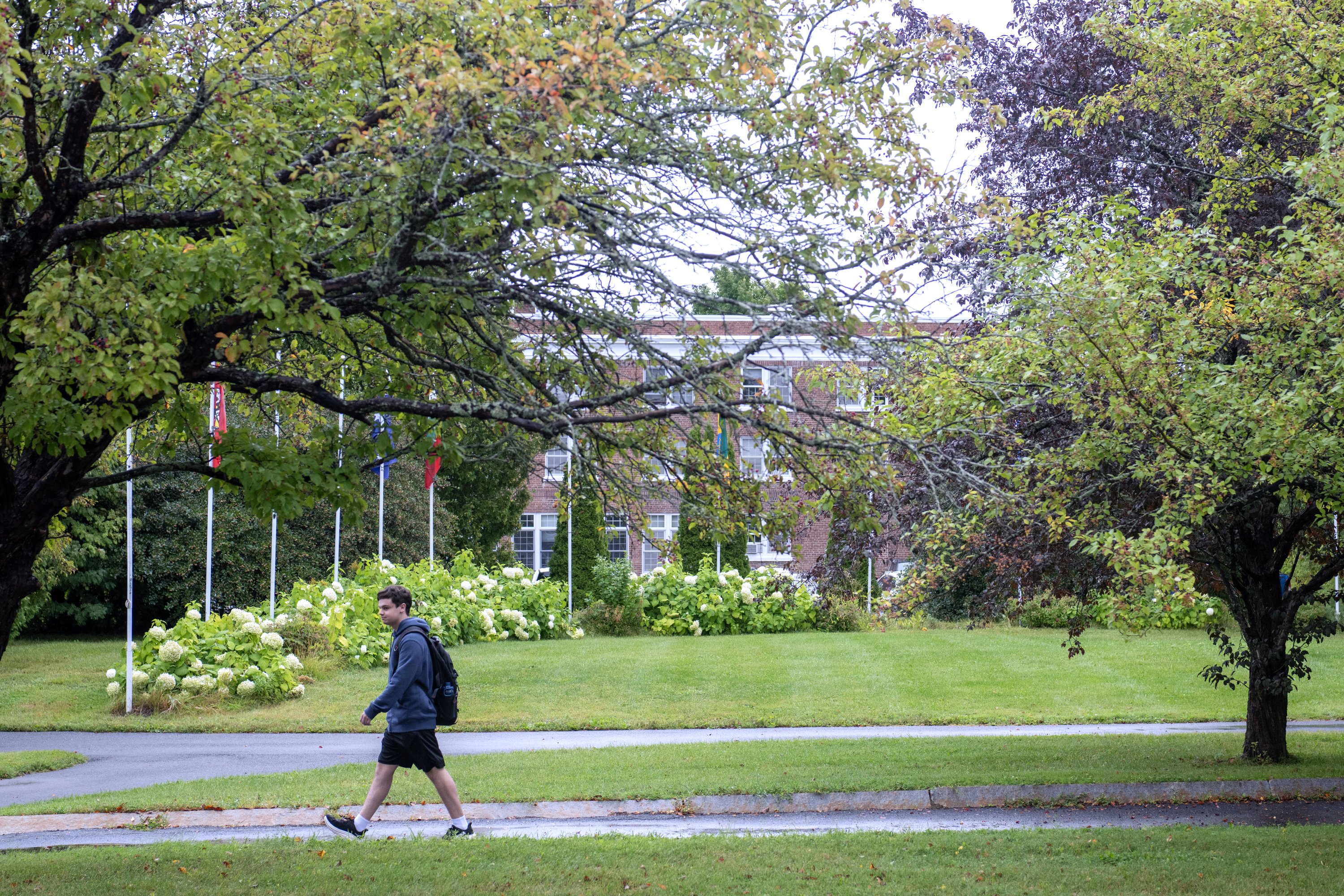 A student walks across campus at the University of Maine at Presque Isle. South Hall is in the background. (Daryn Slover/Staff Photographer)
Purchase this image
A student walks across campus at the University of Maine at Presque Isle. South Hall is in the background. (Daryn Slover/Staff Photographer)
Purchase this imageFor a state that has been clawing and scratching to bring in more young people to fill workforce gaps — and to reverse the tide of student declines in its public universities — YourPace has been a panacea. Earlier this month, the system celebrated a 10-year enrollment high driven almost entirely by the program, while student numbers were down at the largest schools.
But that growth hasn’t come without scrutiny. Last spring, The Washington Post prominently featured YourPace in a piece about students attaining bachelor’s degrees in as little as eight weeks. It prompted the system’s accreditor to request an update from the school addressing concerns about the speed at which some students are getting degrees.
Interviews conducted by the Portland Press Herald with more than two dozen students, faculty members, administrators and local leaders showed an immense pride in the program, which they say has allowed the university to grow and sustain the local workforce despite dire demographic projections, even as some express concern about the emerging method of degree attainment.
Local employers in the business, healthcare and education sectors all said the university is a critical resource in the region, which has seen declining birthrates and low net migration for decades.
 The University of Maine at Presque Isle is commonly referred to as UMPI. (Daryn Slover/Staff Photographer)
Purchase this image
The University of Maine at Presque Isle is commonly referred to as UMPI. (Daryn Slover/Staff Photographer)
Purchase this image“If people from central Aroostook County couldn’t attend UMPI in some form or another, we would struggle,” said Ben Greenlaw, superintendent for the local K-12 school district.
A decade ago, UMPI was the smallest public university in the state. Now, it’s the third largest, and growing. The school has grown its faculty to match, although most courses are now taught by part-time adjuncts.
“We’re very, very proud of the YourPace program, and how fast it’s growing,” said Dannel Malloy, chancellor of the public university system.
Competency based programs have been rising in popularity as traditional four-year degrees become more expensive and less accessible, especially to working adults without the time to sit in a classroom. UMPI is a bit of a rarity in the market as a public university, and it’s still much smaller than the most popular schools for competency based degrees, like Southern New Hampshire University and Western Governors University, which enroll more than 100,000 each.
BOTH/ANDYourPace began in 2017 with an undergraduate business degree and about 100 students. UMPI President Ray Rice said the state was approaching a labor cliff, as lots of people were retiring and not enough people had the credentials to replace them. Adults who had some college credits but still no degree had largely disappeared from the school, and Rice wanted them back.
“This was really something to meet the needs of the county, because we had so many people that were looking to complete degrees,” he said.
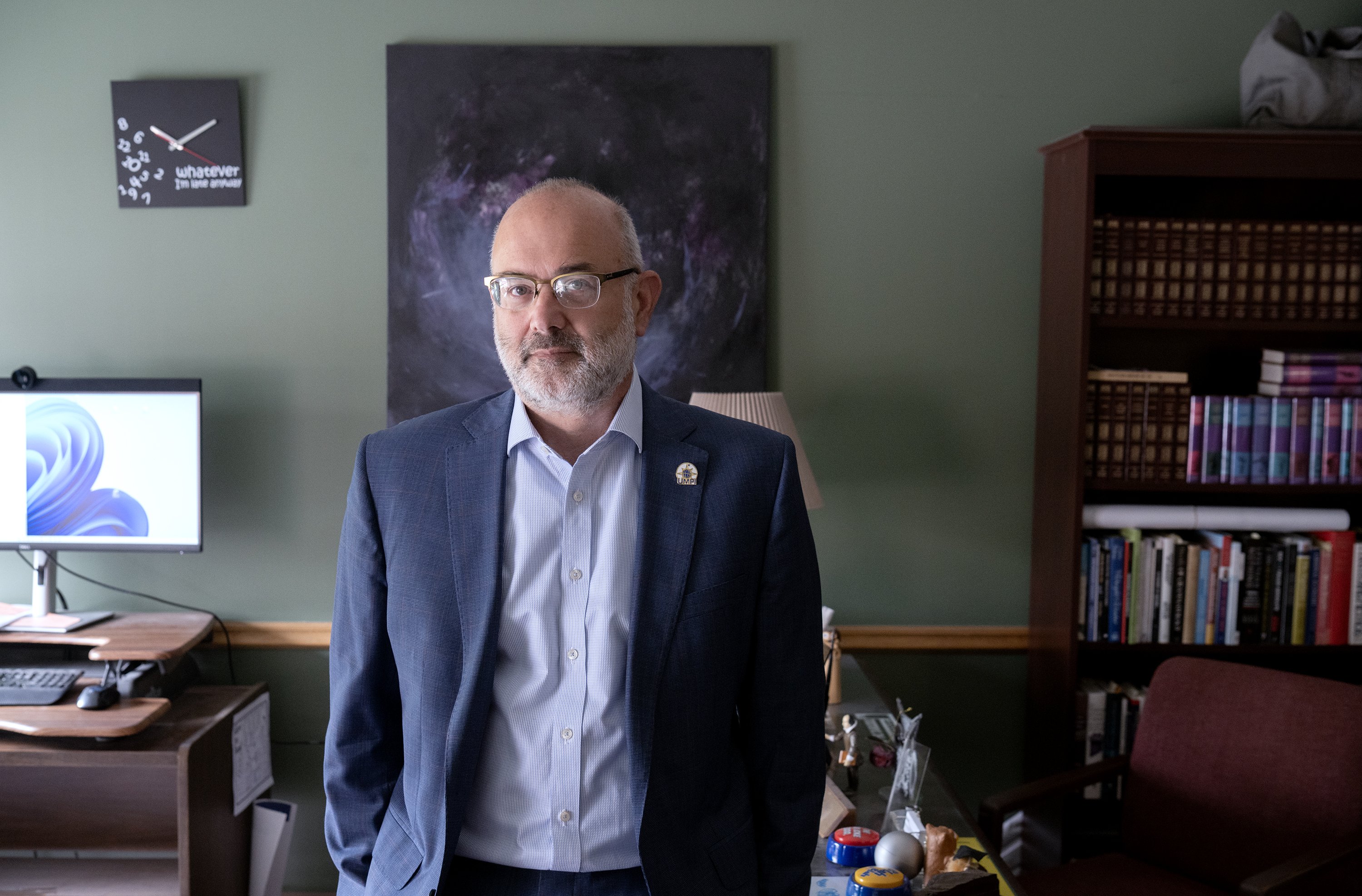 University of Maine at Presque Isle President Ray Rice, in his office in Preble Hall. Rice has been at the university since 1997, when he joined the faculty as an English professor, and has served as president since 2016. (Daryn Slover/Staff Photographer)
Purchase this image
University of Maine at Presque Isle President Ray Rice, in his office in Preble Hall. Rice has been at the university since 1997, when he joined the faculty as an English professor, and has served as president since 2016. (Daryn Slover/Staff Photographer)
Purchase this imageAfter the first degree, UMPI (commonly pronounced UMP-ee) started adding new programs also oriented toward The County’s labor needs, like accounting and supply chain management.
For the next three years, it saw modest enrollment growth. Things changed after the COVID-19 pandemic, which upended higher education and opened peoples’ eyes to the possibilities in online learning.
The program took off, and over the 2021-22 school year it enrolled 603 students. This fall, that reached 3,512, a growth rate of nearly 700% in four years.
YourPace is what’s known as a competency-based degree program, focused on flexibility and prior experience. Undergraduate students pay a flat rate of $1,800 per session, which is about half the length of a traditional 16-week semester, and can receive credit for each course as they complete certain milestones, then demonstrate mastery on a final assessment. There are no set meeting times, no lectures and students can finish at whatever speed they like. Most will never meet their classmates.
The program is specifically designed for adults (it’s only open to students age 20 or older) who have some number of college credits already. Students can also earn credit for non-college learning, like online trainings, job experience or through custom exams that evaluate prior knowledge of a subject, but they are required to take at least 30 credits (a quarter of what’s needed for an undergraduate degree) at UMPI. The average student brings in about 91 credits, and more than 90% finish their degree in less than a year, according to school officials.
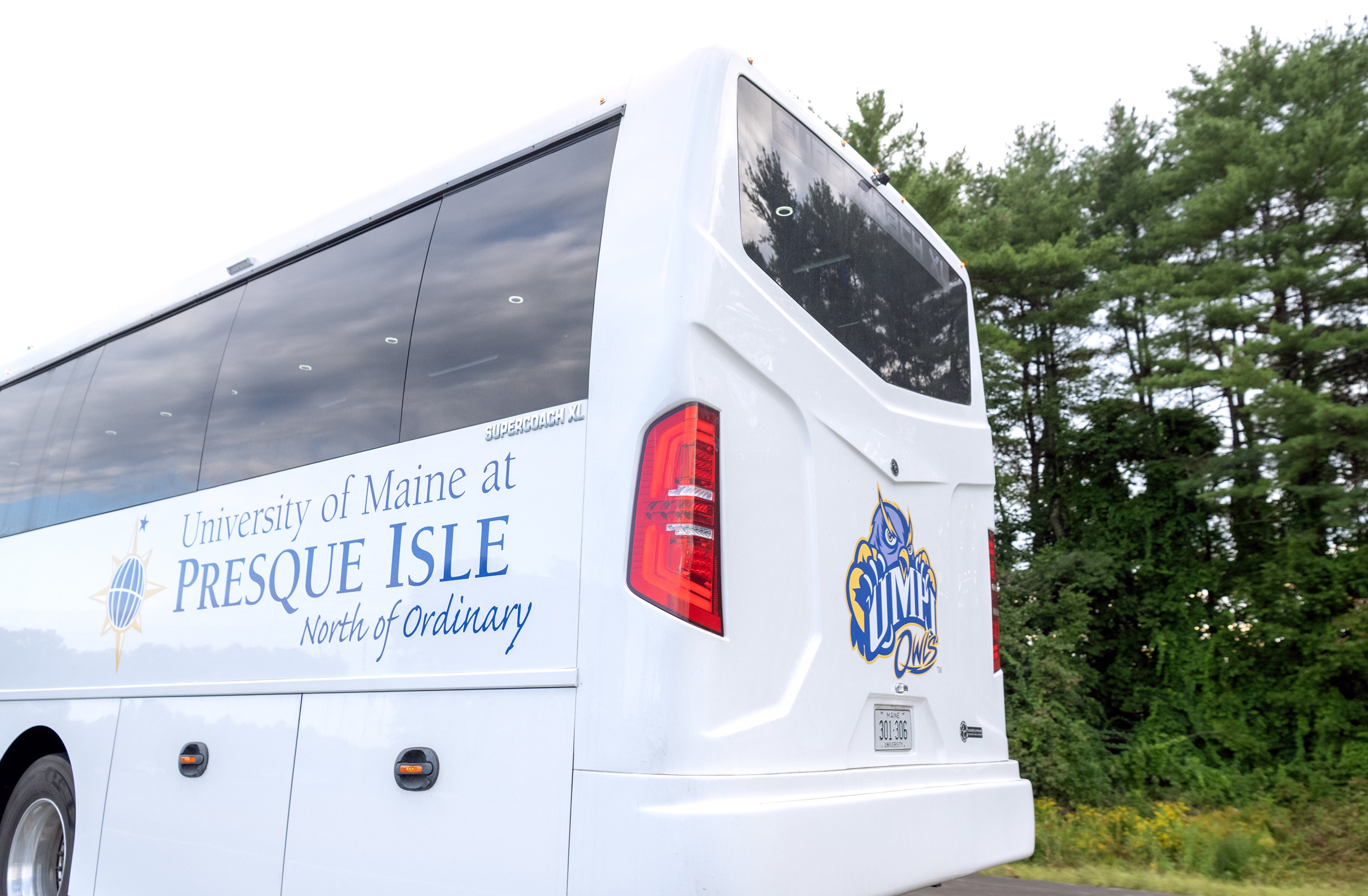 A coach bus from the University of Maine at Presque Isle travels south on Interstate 95 near Waterville on Friday, Sept. 4. (Daryn Slover/Staff Photographer)
Purchase this image
A coach bus from the University of Maine at Presque Isle travels south on Interstate 95 near Waterville on Friday, Sept. 4. (Daryn Slover/Staff Photographer)
Purchase this imageRice said when he joined the university in 1997 as an English professor, three quarters of students were from Aroostook County. If it had stayed that way, the school would have shrunk by more than 60%, based on trends in how many county high school graduates are seeking a college degree.
“So simultaneously, this allows us to meet state workforce needs, but tap into national revenues,” he said.
In recent years, the scales have tipped sharply. YourPace students now outnumber traditional students nearly four to one, and about 87% come from out of state. The largest groups of students are from the south, southwest and west coast. Most will never come to campus — only about 22% of YourPace students walked at the graduation ceremony last spring.
Rice calls it a “both/and” situation. The university continues to provide critical training in areas like teaching and nursing to students who can’t leave Aroostook County for their degrees, and the online program is the engine that allows them to do so. It is both a rural public university and a major online competency-based degree program.
YourPace accounted for 96% of the university’s revenue growth last year, according to its latest budget presentation. While income from traditional tuition declined, YourPace revenue grew by nearly 50%, from $16 million to $23.5 million.
Thanks to YourPace, Rice said, the school can do long-needed upgrades to its physical campus, and make new investments, like the $2 million it put into a new dental assistant program, set to launch next year.
“There was no way we would have been able to do that if we didn’t have the revenue coming from a national program,” he said.
THE HUB OF AROOSTOOK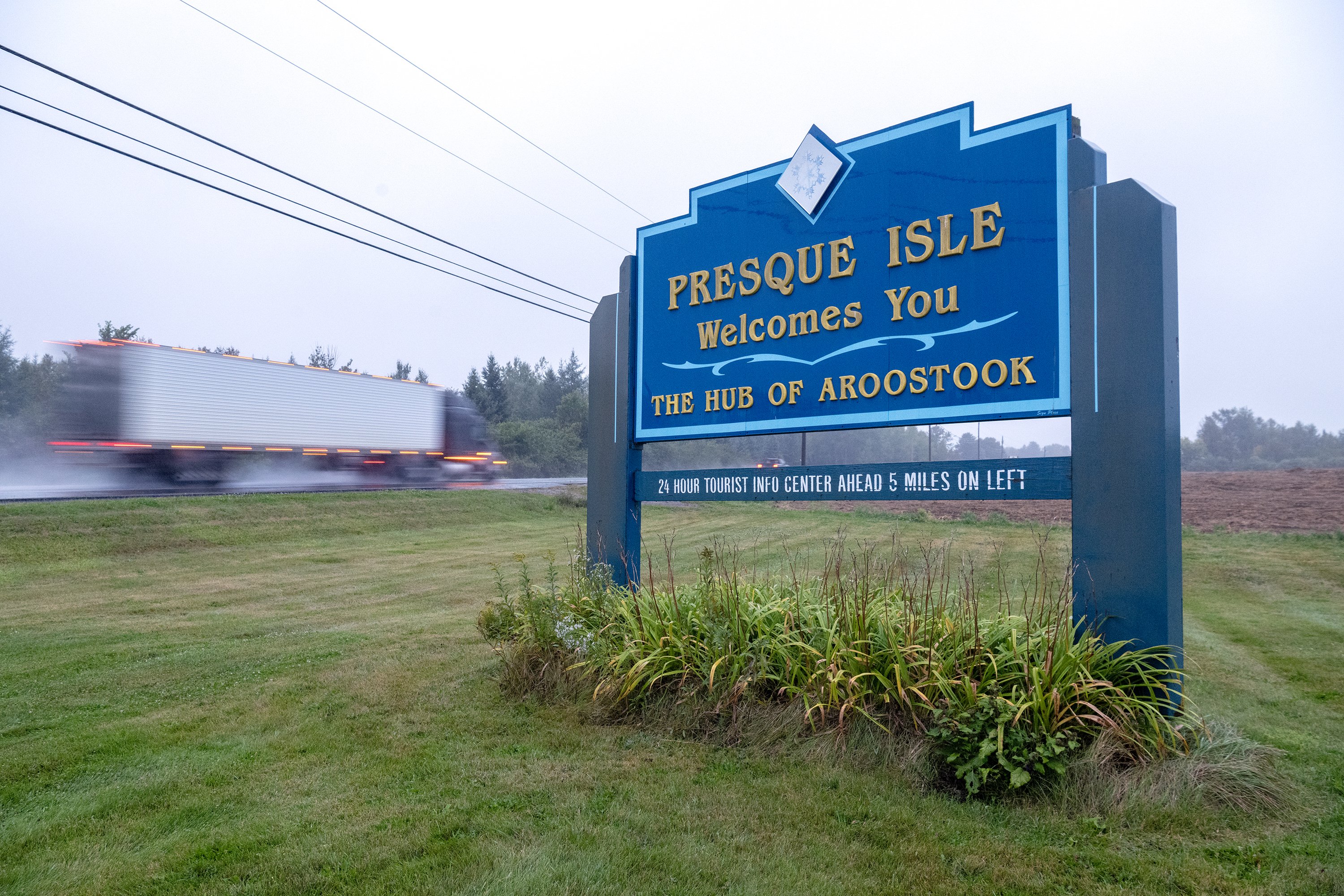 A sign along Route 1 south of the city welcomes visitors to Presque Isle. (Daryn Slover/Staff Photographer)
Purchase this image
A sign along Route 1 south of the city welcomes visitors to Presque Isle. (Daryn Slover/Staff Photographer)
Purchase this imagePresque Isle, population 8,694, is the largest city in Maine’s largest-sized county, 20 minutes from the Canadian border and two-and-a-half hours north of Bangor. On the drive up Route 1, dozens of roadside stands offer new potatoes, the county’s largest and most quintessential crop.
Local leaders don’t hesitate to expound the university’s essentialness. Around town, everyone has a kid or spouse with an UMPI degree, or has one themself.
It goes back to the university’s roots as Aroostook State Normal School, a teacher college founded in 1903 by the Rev. George Park.
“He said, ‘Wouldn’t it be nice if we had a college here so that our kids didn’t have to leave to go to school?’ said Kim Smith, a resource development officer for the city who also sits on local tourism and museum boards. “And I think we’re still saying that.”
UMPI remains a major contributor to critical local services. Across town at Northern Light A.R. Gould Hospital — the county’s largest employer — many of the of the clinical staff have an UMPI degree. The university’s nursing, medical lab technology and physical therapy programs all support hospital staffing, but also necessary business and financial roles, said Laura Turner, the hospital’s director of community outreach.
Of those who graduate from the nursing program shared between UMPI and the University of Maine at Fort Kent, 90% stay in Maine to practice nursing, and 40% stay in the county. Rice said the school “can’t produce enough lab techs for the state, let alone for up here,” since many technicians can quickly find higher-paying jobs in bigger cities.
Just down the road from the hospital at Presque Isle High School, UMPI grads also fill the halls. As a geographically isolated community, Superintendent Greenlaw said, Maine School Administrative District 1 is rarely hiring employees who move to the area for work.
“If we don’t invest and try to grow our own, and if we didn’t have a place like UMPI down the road, we wouldn’t be able to fully staff our classrooms,” he said.
That’s why MSAD 1 and UMPI collaborate on an apprenticeship program, which allows educational technicians to earn a teaching degree while working full time at the district.
The K-12 schools are fighting the same demographic headwinds as the university. MSAD 1 lost 8% of its student enrollment over the past decade, and is set to lose another 9% over the next one, per a study of birthrates at the local hospital. The high school has dwindled to less than half the size it was in the ’80s, and the district is looking into consolidating with the high schools in nearby Caribou and Fort Fairfield to pool resources.
The university benefits Presque Isle in other ways, too. Its pool and athletic facilities are used by the school district and community, its library is used by the city for large events; Turner at the hospital said they’re able to attract doctors to move to the area because of the sports and arts events the university offers.
New hiring growth related to the YourPace boom supports households and increases local spending, city manager Sonja Eyler said.
“Presque Isle and UMPI share a future,” she said.
SOCRATES SITTING ON HIS PORCHYourPace was the centerpiece of an April 19 Washington Post article about so-called college “speed runners” who try to obtain a college degree in as little time as possible by racking up credits from non-collegiate online tutorial programs like Sophia Learning, then taking as many courses as possible in one session.
The story quoted the president of the school’s accreditor, Larry Schall of the New England Commission of Higher Education, as saying he “had never heard of students completing a bachelor’s degree in only a few months — either at the Presque Isle campus or any other accredited university,” and that he planned to investigate the issue.
The commission requested an update on YourPace completion times, which the system submitted in August. (All University of Maine System schools are jointly accredited as of 2020.)
“The article’s claim, that students complete bachelor’s degrees in as little as sixteen weeks, describes only the end of an academic journey, not the history of that journey itself,” the update reads.
However, it said, public attention from the article identified the need for more systematic monitoring of “accelerated progress,” a hard look at the transfer credit policy and better public communication about how YourPace degrees are earned.
Rapid completers, the school said in its report, are a minority. Last spring, 21% of students finished 10 or more courses in the semester, and 11% completed 12 or more. The average student completes five courses in that time.
The commission will consider that response, and whether to take any action, at its next regular meeting at the end of September.
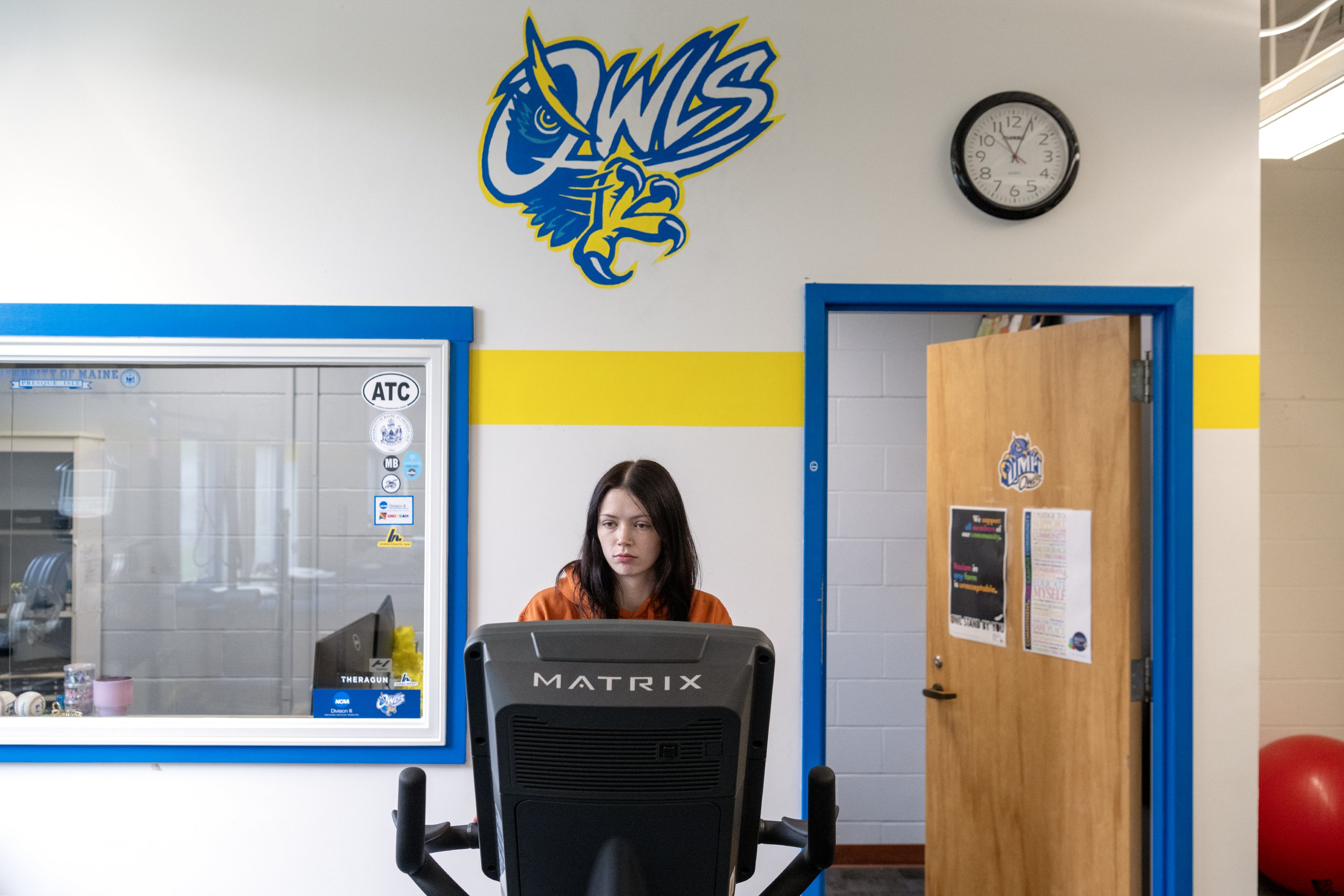 Student athlete Jade Anspach works out in the University of Maine at Presque Isle’s athletic training room. Anspach plays on the volleyball team and is from Pueblo, Colorado. (Daryn Slover/Staff Photographer)
Purchase this image
Student athlete Jade Anspach works out in the University of Maine at Presque Isle’s athletic training room. Anspach plays on the volleyball team and is from Pueblo, Colorado. (Daryn Slover/Staff Photographer)
Purchase this imageThe impact of the Post article has reverberated beyond Presque Isle. Brian McGill, an ecology professor at the flagship UMaine, said faculty there have growing concerns about the reputational harm that YourPace may be doing.
“If there’s a national news story about UMPI and the amount of time it takes to get a degree, are people going to assume that’s reflecting on the quality of the University of Maine degree?” McGill said. His colleagues also have worries about joint accreditation, he said, and whether YourPace students are adequately prepared to transfer to other system universities.
UMPI Provost Alana Margeson said it’s fair to ask questions about academic program quality, but said the school has achieved accreditation every step of the way. Rice said academics had the same apprehensions back when online programs first became popular, but studies ultimately proved the comparable rigor of those degrees.
 President Ray Rice talks to reporters on the University of Maine at Presque Isle’s campus. (Daryn Slover/Staff Photographer)
Purchase this image
President Ray Rice talks to reporters on the University of Maine at Presque Isle’s campus. (Daryn Slover/Staff Photographer)
Purchase this image“Well OK, it’s not Socrates sitting with a bunch of students on his porch,” Rice joked. “But education has changed, and you find a way to ensure that whatever pedagogy you’re using is authentically as engaging as those previous ones.”
Dannel Malloy, the chancellor of the system, said everybody might not agree about the system’s embrace of YourPace, but students today are making their decisions differently. Faculty shouldn’t be surprised, he said, that they’re taking advantage of a tool that allows them to complete a college degree when they wouldn’t have been able to before.
YOU BELONG HEREFor several years now, YourPace at UMPI has been the primary driver of growth in the seven-school University of Maine System.
System Chancellor Dannel Malloy penned an op-ed in 2024 touting the program as a way to help the 190,000 adults in Maine with some college but no degree to realize their full potential. He said it was an example of the system’s evolution to better serve adult learners, “consistent with Maine’s 10-year economic strategy of growing local talent and our own new strategic plan.”
Asked about how YourPace today aligns with that economic strategy, Malloy said its growth also creates growing opportunities for Mainers.
“The success of this program — sure, it allows it to grow across the country, and to other countries as well,” he said. “But if it didn’t have that, then it would be difficult to be serving the Maine audience of people. These things are tied together.”
Across the system, 28% of out-of-state students stay in Maine to work after graduation. However, just 14% of UMPI’s out-of-state students stay in state, according to data from the system’s post-grad employment survey from 2023 through 2025.
Traditional student enrollment at UMPI is actually up over last year, but down compared to a decade ago.
On the first Friday of the new academic semester, students wandered from class to class, enjoying unexpected sunshine. Many are athletes, here from other regions of the county to play Division III baseball or soccer. Others, like 18-year-old Ally Shields from Dyer Brook or 21-year-old Neo Koch from Washburn, haven’t come very far at all.
“Everyone makes you feel like you belong here,” Shields, a physical therapy assistant student, said in the hall on her way to class. For Koch, who lives at home and commutes, the decision to attend UMPI came down to proximity and cost-savings.
Traditional students said they are aware that YourPace is a good option for adult learners, but not for them. Some were surprised to learn how large the program had grown.
Alexei Olmstead, a psychology student on the pre-med track, chose UMPI because it’s close to her home in Caribou, and because she wanted a small school feel. Olmstead is familiar with YourPace because her mom is a faculty member, and understands its value for adults who are trying to work full-time or parent while seeking a degree. But to her, the purpose of school is face-to-face interaction.
“The college experience is the college experience, and it’s kind of hard to replicate that online,” Olmstead said.
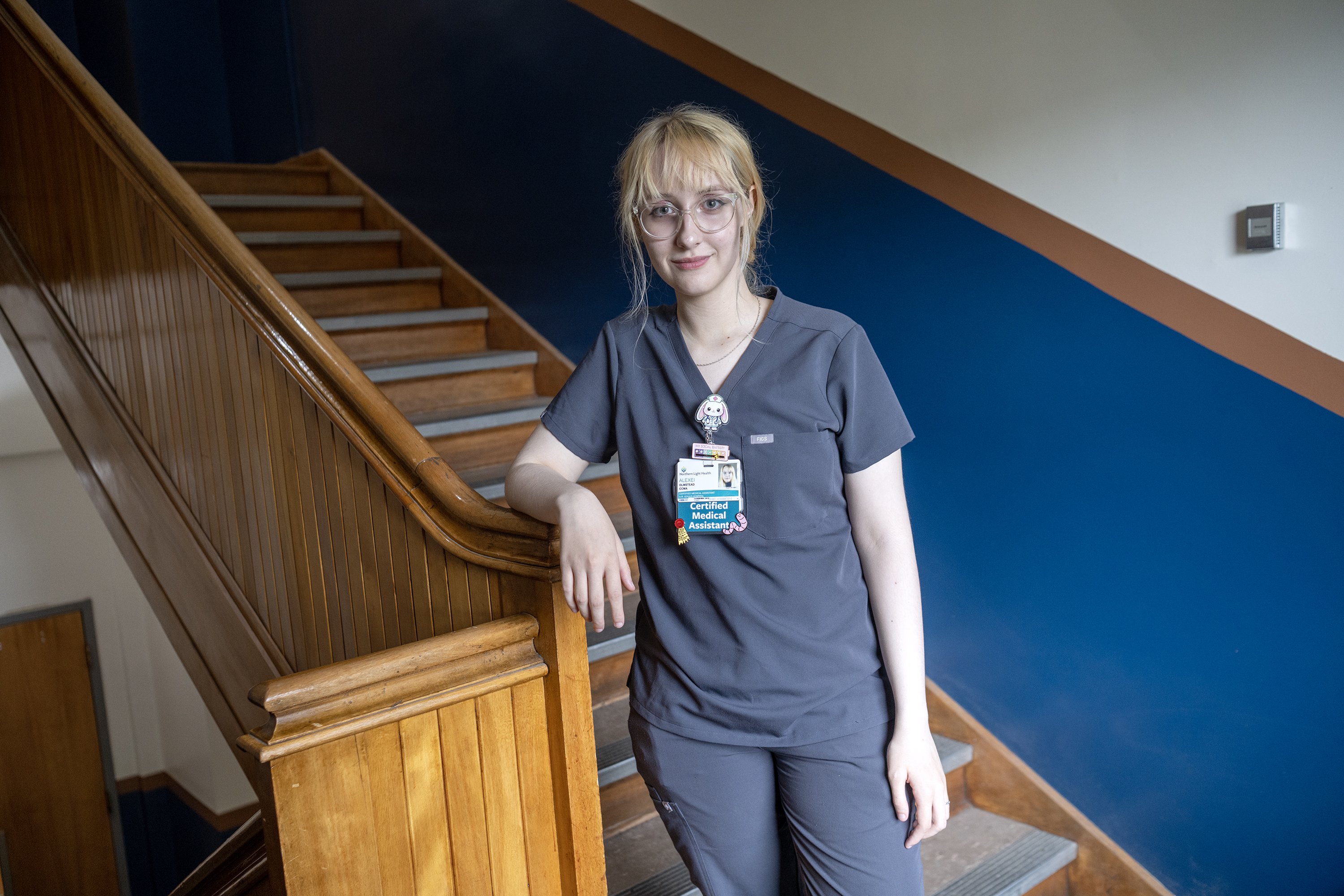 Alexei Olmstead, a psychology student at the University of Maine at Presque Isle, is on the pre-med track, and working to get 500 clinical hours at a hospital-run infusion clinic. (Daryn Slover/Staff Photographer)
Purchase this image
Alexei Olmstead, a psychology student at the University of Maine at Presque Isle, is on the pre-med track, and working to get 500 clinical hours at a hospital-run infusion clinic. (Daryn Slover/Staff Photographer)
Purchase this imageMost full-time faculty members teach both in-person courses and YourPace. Literature professor Lea Allen said the competency learning was a bit hard to wrap her head around at first, but became familiar. Faculty have a 72-hour window to respond to student emails and assignments, which Allen said she does on a flexible basis, like early in the morning, or late at night during her daughter’s hockey games.
One advantage of YourPace, for Allen, has been the wider audience that might be interested in niche courses, which UMPI won’t run on campus unless six students are signed up. You only need one student to run a course in YourPace, she said.
 Associate Professor of English Lea Allen passes a map of the world in Folsom Hall at the University of Maine at Presque Isle. (Daryn Slover/Staff Photographer)
Purchase this image
Associate Professor of English Lea Allen passes a map of the world in Folsom Hall at the University of Maine at Presque Isle. (Daryn Slover/Staff Photographer)
Purchase this imageLately, to keep up with rising enrollment, the university has been growing its YourPace staff with part-time adjuncts, who now teach 67% of the courses. A university spokesperson said regardless of who does the teaching, all courses are reviewed by full-time faculty. Just over half of faculty, full and part-time, are local to the region.
UMPI leaders said there’s no specific target or cap for how much YourPace will grow. The system has an overall goal to double its online offerings by 2028, and two other system universities, in Fort Kent and Farmington, now offer YourPace courses.
“It’s happening,” Malloy, the chancellor, said. “The reality is it’s happening around the nation.”
| # | Наименование новости | Тональность | Информативность | Дата публикации |
|---|---|---|---|---|
| 1 | UMaine System projects 10-year high in enrollment as classes begin | 0 | 35.24 | 31-08-2026 |
| 2 | UMaine announces planned staff and faculty layoffs to address projected $19M shortfall | 0 | 35.39 | 17-09-2026 |
| 3 | University of Vermont to offer tuition discount to Maine students in select majors | 0 | 33.3 | 09-09-2026 |
| 4 | Bowdoin climbs to No. 3 in national rankings of best colleges | 0 | 35.06 | 22-09-2026 |
| 5 | Maine’s first recovery high school opens to help teens get off drugs | 0 | 33.88 | 19-08-2026 |
| 6 | Maine Teacher of the Year finalists give advice for new educators: ‘Just go for it. Be yourself’ | 0 | 37.48 | 20-09-2026 |
| 7 | Windham instructor a finalist for Maine Teacher of the Year | 0 | 37.55 | 04-09-2026 |
| 8 | Millions in federal dollars for short-term workforce training programs come to Maine | 0 | 36.53 | 08-09-2026 |
| 9 | Meet Kennebunk Elementary School’s new principal | 0 | 34.53 | 19-09-2026 |
| 10 | Here’s what’s changed in Cumberland-North Yarmouth schools as students return | 0 | 38.14 | 31-08-2026 |


