Просмотр новости
Найдите то, что Вас интересует
 Спутники
 РН
РН SpaceX
 Роскосмос
 NASA
NASA
СпутникиРНSpaceXРоскосмосNASA
In all the cosmos, pulsars are the most precise long-term way to measure time.
The rate of orbital decay of a binary pulsar is highly dependent on the speed of gravity and the orbital parameters of the binary system. We have used binary pulsar data to constrain the speed of gravity to be equal to the speed of light to a precision of 99.8%, and to infer the existence of gravitational waves decades before LIGO and Virgo detected them. Here, double pulsar J0737-3039 is illustrated, with the observed relativistic time delay shown at right.
Credits: M. Kremer/MPIfRA
Each time these magnetized neutron stars complete a rotation, a pulse of radiation emerges.
This most up-to-date view of the nebula MSH 15-52 in X-ray light comes courtesy of NASA’s Chandra X-ray Observatory. Note that the pulsar, at the center of the “base” of the hand, is offset from the supernova remnant itself, near the top-right of the image, indicating that the neutron star has been blown aside with an incredibly rapid kick at about 5% of the speed of light.
Credit: NASA/CXC/Univ. of Hong Kong/S. Zhang et al.
When pulses intersect your line-of-sight, you’ll observe rapid, periodic bursts.
With a very strong surrounding magnetic field, pulsars accelerate matter around them and collimate them in jets that get emitted around two poles. As the neutron star rotates, the emitted jets rotate, and each time one of the jets crosses your line-of-sight, you observe a pulse of emissions: typically at radio frequencies, but often also at other frequencies as well.
Credit: J. van Leeuwen
The fastest-spinning ones, millisecond pulsars, are the most accurate and stable pulsars for timekeeping purposes.
Using the combined data from NASA’s Chandra (X-ray), Hubble (visible light), and IXPE (X-ray polarization, in light blue), pulsar winds coming off of the Vela pulsar, a neutron star just ~10,000 years old, can easily be seen. These jets, if the pulsar has a binary companion (Vela has a high-mass one), can damage or even potentially destroy the companion star. Initially, all pulsars have slow rotational periods, but many with companions, including possibly this one, will evolve into millisecond pulsars.
Credits: X-ray: (IXPE) NASA/MSFC/Fei Xie & (Chandra) NASA/CXC/SAO; Optical: NASA/STScI Hubble/Chandra processing by Judy Schmidt; Hubble/Chandra/IXPE processing & compositing by NASA/CXC/SAO/Kimberly Arcand & Nancy Wolk
The first pulsar was found in 1967, with the first millisecond pulsar discovered in 1982.
This illustration shows a neutron star with an accretion disk, siphoning mass off of a low-mass companion star. Many of these systems with neutron stars will have millisecond pulsars for their neutron stars, and the neutron star’s pulsing “jets” will strike, and slowly destroy or drive to extinction, the companion star.
Credit: Vdsluys/Wikimedia Commons
Only with subsequent advances did laboratory-based atomic clocks surpass pulsars in timekeeping precision.
JILA’s three-dimensional (3-D) quantum gas atomic clock consists of a grid of light formed by three pairs of laser beams. A stack of two tables is used to configure optical components around a vacuum chamber. Shown here is the upper table, where lenses and other optics are mounted. A blue laser beam excites a cube-shaped cloud of strontium atoms located behind the round window in the middle of the table. Strontium atoms fluoresce strongly when excited with blue light, creating the laser-like sight viewed here.
Credit: G.E. Marti/JILA
For millisecond pulsars, the average time between pulses can be known to ~15 significant figures.
These are the 68 millisecond pulsars included in the 15-year NANOGrav data, color-coded by frequencies observed, observatories that saw them, and duration of the observations. As more pulsars were observed by more observatories, the data became more sensitive to any background gravitational wave signals. Over long baseline periods, the average pulse time can be known to up to 15 significant figures of precision.
Credit: NANOGrav Collaboration (G. Agazie et al.), ApJL, 2023
With 100+ pulses-per-second, that translates to microsecond-level precision over multi-decade timescales.
This artist’s impression shows the optical features of a millisecond pulsar-brown dwarf system. Pulsars in these systems are known as “black widows” because they prey on their companions, with pulsar winds firing particles and ablating material off of the low-mass companion.
Credit: NASA/CXC/M.Weiss
However, on rare occasions, pulsars change in abrupt fashion.
This side-by-side set of images shows a series of views of the Crab Pulsar and its surrounding environment taken by NASA’s Chandra X-ray telescope (left) and NASA’s Hubble space telescope (right) over the 6-month period from November 2000 to April 2001. Formed from a star that went supernova in 1054, the Crab Pulsar is one of the youngest known neutron stars, and the ringed feature around the pulsar was only discovered due to Chandra’s then-revolutionary X-ray capabilities. The period of this neutron star has glitched several times since it has been identified, with its rotational period shortening.
Credits: NASA/CXC/ASU/J.Hester et al.; NASA/HST/ASU/J.Hester et al.; stevebd1/YouTube
When glitching, their rotational speed suddenly accelerates.
This computer simulation of a neutron star shows charged particles being whipped around by a neutron star’s extraordinarily strong electric and magnetic fields. It is possible that a neutron star has formed within the remnant of SN 1987A, but the region is still too dusty and gas-rich for the “pulses” to seep out. Neutron star surfaces are at similar temperatures to white dwarf interiors: typically at several hundred thousand kelvin.
Credit: NASA’s Goddard Space Flight Center
Are these “glitches” starquakes?
Many high-mass binary systems will wind up with a high-mass blue supergiant at the center of a system, which will eventually go supernova and produce a neutron star. A less massive star that orbits it can serve as a donor star: lending mass to the neutron star until it spins up and achieves hundreds of rotations per second. Over time, the mass distribution of the neutron star rearranges itself, leading to faster and faster rotations.
Credit: Walt Feimer, NASA/Goddard Space Flight Center
In addition to glitches, the observed shape of the radio pulse can change.
This image shows the illustration of a massive neutron star, along with the distorted gravitational effects an observer might see if they had the capability of viewing this neutron star at such a close distance. While neutron stars are famous for pulsing, not every neutron star is a pulsar. The fastest pulsars, known as millisecond pulsars, rotate at more than 100 times per second, with “glitches” speeding up the rotation rate of these pulsars.
Credit: Daniel Molybdenum/flickr and raphael.concorde/Wikimedia Commons
Pulse profile changes, once thought rare, definitely aren’t starquakes.
This observation of pulsar J0437-4715 shows the central pulsar/white dwarf combination, where the light output is dominated by the white dwarf component, and the faint red, looping structure that results from the combined magnetic field that the white dwarf and pulsar carve together.
Credit: Adam Block/ObsTech/Chile
The closest millisecond pulsar, PSR J0437-4715, is just 510 light-years away.
This figure shows the bow shock and ionization features associated with a bubble carved into the surrounding plasma by the combination of a white dwarf and a millisecond pulsar around the closest, brightest millisecond pulsar to Earth: PSR J0437-4715, four arcs, among more than 20 other features, exist within 5000 AU of the pulsar/white dwarf system.
Credit: D.J. Reardon et al., Nature Astronomy submitted/arXiv:2410.21390, 2026
It possesses a white dwarf companion.
Two pulse profile changes were recently reconstructed: in 2017 and 2022.
This graph shows (at least) two abrupt transitions in the pulse phase of the millisecond pulsar J0437-4715, with the central bright peak corresponding to the average pulse phase and the two leftmore peaks corresponding to the spontaneous changes that occurred in the pulse profile.
Credit: R.F. Mandow et al., MNRAS submitted/arXiv:2609.15263, 2026
Combined with PSR 1713+0747’s similar change, polarization-based analyses favor magnetospheric, not seismic, origins.
This animation provides a tour around an isolated pulsar’s simulated magnetic field. In the presence of another highly magnetized object, such as a white dwarf, the field lines can easily become complex, can interact, and lead to magnetic reconnection events. If pulse timing is dependent on the surrounding magnetic field, this can influence the timing period of the pulsar.
Credit: NASA’s Scientific Visualization Studio
Perhaps millisecond pulsars aren’t as stable, long-term, as once believed.
This illustration shows how the Earth, itself embedded within spacetime, sees the arriving signals from various pulsars delayed and distorted by the background of cosmic gravitational waves that propagate all throughout the Universe. The combined effects of these waves alters the timing of each and every pulsar, and a long-timescale, sufficiently sensitive monitoring of these pulsars can reveal those gravitational signals. If millisecond pulsars are less stable than thought, these pulse profile changes must be included in each pulsar’s evolution to successfully tease out any gravitational wave signals from the cumulative data.
Credit: Tonia Klein/NANOGrav
Mostly Mute Monday tells an astronomical story in images, visuals, and no more than 200 words.
This article Most accurate cosmic clocks show unexpected instability is featured on Big Think.
by
September 21, 2026

A combination of X-ray, optical, and infrared data reveal the central pulsar at the core of the Crab Nebula, including the winds and outflows that the pulsars carry in the surrounding matter. The central bright purplish-white spot is, indeed, the Crab pulsar, which itself spins at about 30 times per second, but will speed up over time. The material shown here spans about 5 light-years in extent, originating from a star that went supernova about 1,000 years ago, teaching us that the typical speed of the ejecta is around 1,500 km/s. The neutron star originally reached a temperature of ~1 trillion K, but even now, it's already cooled to "only" about 600,000 K.
Credit: X-ray: NASA/CXC/SAO; Optical: NASA/STScI; Infrared: NASA-JPL-Caltech
In all the cosmos, pulsars are the most precise long-term way to measure time.
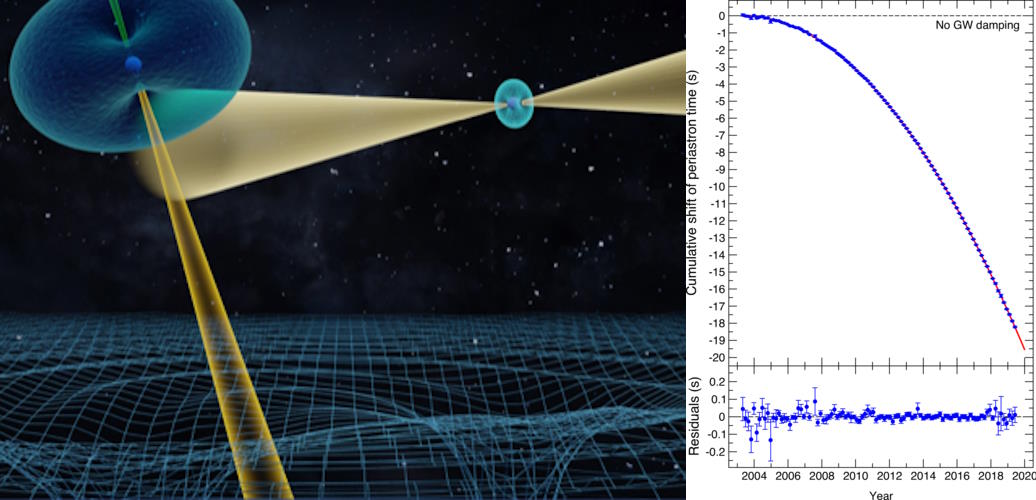
The rate of orbital decay of a binary pulsar is highly dependent on the speed of gravity and the orbital parameters of the binary system. We have used binary pulsar data to constrain the speed of gravity to be equal to the speed of light to a precision of 99.8%, and to infer the existence of gravitational waves decades before LIGO and Virgo detected them. Here, double pulsar J0737-3039 is illustrated, with the observed relativistic time delay shown at right.
Each time these magnetized neutron stars complete a rotation, a pulse of radiation emerges.

This most up-to-date view of the nebula MSH 15-52 in X-ray light comes courtesy of NASA’s Chandra X-ray Observatory. Note that the pulsar, at the center of the “base” of the hand, is offset from the supernova remnant itself, near the top-right of the image, indicating that the neutron star has been blown aside with an incredibly rapid kick at about 5% of the speed of light.
When pulses intersect your line-of-sight, you’ll observe rapid, periodic bursts.

With a very strong surrounding magnetic field, pulsars accelerate matter around them and collimate them in jets that get emitted around two poles. As the neutron star rotates, the emitted jets rotate, and each time one of the jets crosses your line-of-sight, you observe a pulse of emissions: typically at radio frequencies, but often also at other frequencies as well.
The fastest-spinning ones, millisecond pulsars, are the most accurate and stable pulsars for timekeeping purposes.

Using the combined data from NASA’s Chandra (X-ray), Hubble (visible light), and IXPE (X-ray polarization, in light blue), pulsar winds coming off of the Vela pulsar, a neutron star just ~10,000 years old, can easily be seen. These jets, if the pulsar has a binary companion (Vela has a high-mass one), can damage or even potentially destroy the companion star. Initially, all pulsars have slow rotational periods, but many with companions, including possibly this one, will evolve into millisecond pulsars.
Credits: X-ray: (IXPE) NASA/MSFC/Fei Xie & (Chandra) NASA/CXC/SAO; Optical: NASA/STScI Hubble/Chandra processing by Judy Schmidt; Hubble/Chandra/IXPE processing & compositing by NASA/CXC/SAO/Kimberly Arcand & Nancy Wolk
The first pulsar was found in 1967, with the first millisecond pulsar discovered in 1982.
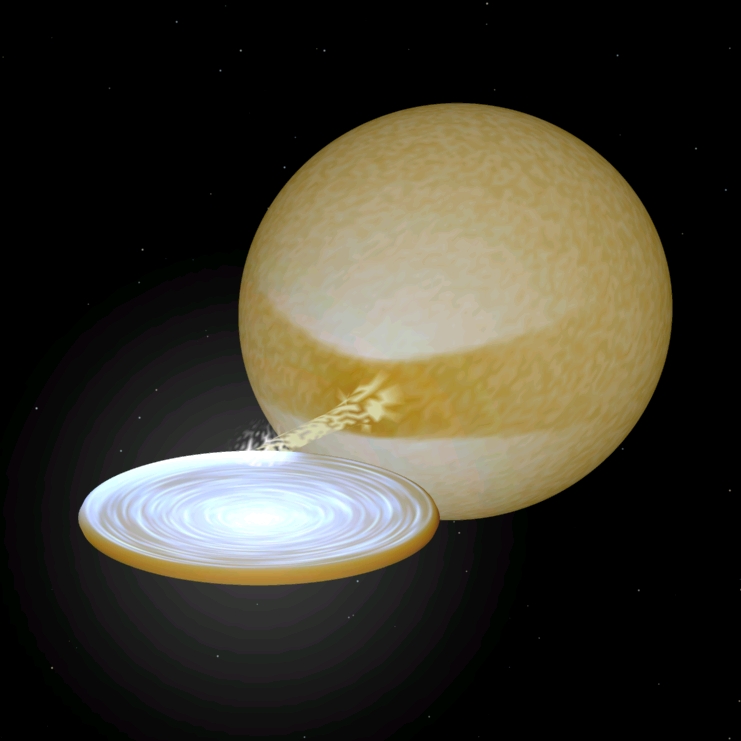
This illustration shows a neutron star with an accretion disk, siphoning mass off of a low-mass companion star. Many of these systems with neutron stars will have millisecond pulsars for their neutron stars, and the neutron star’s pulsing “jets” will strike, and slowly destroy or drive to extinction, the companion star.
Only with subsequent advances did laboratory-based atomic clocks surpass pulsars in timekeeping precision.

JILA’s three-dimensional (3-D) quantum gas atomic clock consists of a grid of light formed by three pairs of laser beams. A stack of two tables is used to configure optical components around a vacuum chamber. Shown here is the upper table, where lenses and other optics are mounted. A blue laser beam excites a cube-shaped cloud of strontium atoms located behind the round window in the middle of the table. Strontium atoms fluoresce strongly when excited with blue light, creating the laser-like sight viewed here.
For millisecond pulsars, the average time between pulses can be known to ~15 significant figures.

These are the 68 millisecond pulsars included in the 15-year NANOGrav data, color-coded by frequencies observed, observatories that saw them, and duration of the observations. As more pulsars were observed by more observatories, the data became more sensitive to any background gravitational wave signals. Over long baseline periods, the average pulse time can be known to up to 15 significant figures of precision.
Credit: NANOGrav Collaboration (G. Agazie et al.), ApJL, 2023
With 100+ pulses-per-second, that translates to microsecond-level precision over multi-decade timescales.

This artist’s impression shows the optical features of a millisecond pulsar-brown dwarf system. Pulsars in these systems are known as “black widows” because they prey on their companions, with pulsar winds firing particles and ablating material off of the low-mass companion.
However, on rare occasions, pulsars change in abrupt fashion.
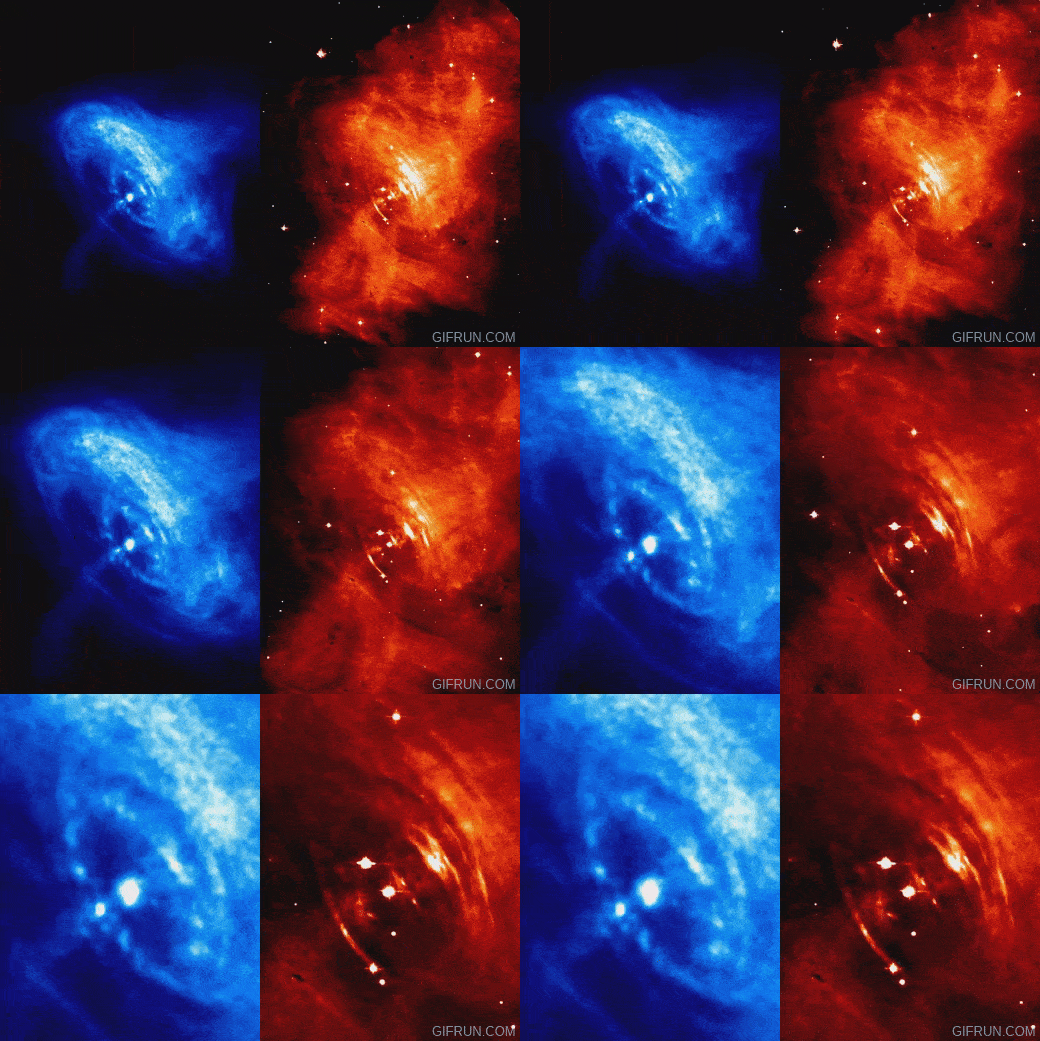
This side-by-side set of images shows a series of views of the Crab Pulsar and its surrounding environment taken by NASA’s Chandra X-ray telescope (left) and NASA’s Hubble space telescope (right) over the 6-month period from November 2000 to April 2001. Formed from a star that went supernova in 1054, the Crab Pulsar is one of the youngest known neutron stars, and the ringed feature around the pulsar was only discovered due to Chandra’s then-revolutionary X-ray capabilities. The period of this neutron star has glitched several times since it has been identified, with its rotational period shortening.
Credits: NASA/CXC/ASU/J.Hester et al.; NASA/HST/ASU/J.Hester et al.; stevebd1/YouTube
When glitching, their rotational speed suddenly accelerates.
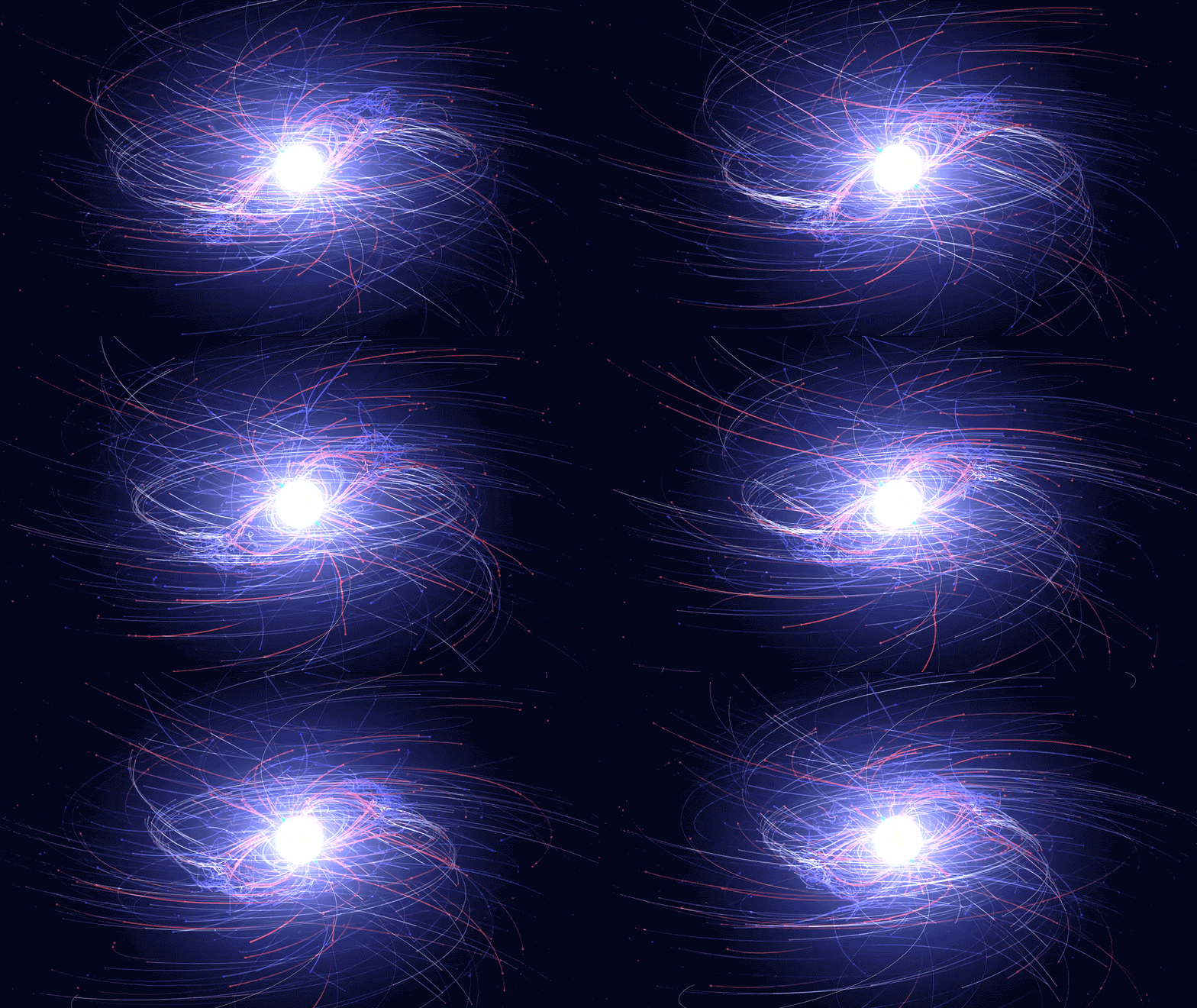
This computer simulation of a neutron star shows charged particles being whipped around by a neutron star’s extraordinarily strong electric and magnetic fields. It is possible that a neutron star has formed within the remnant of SN 1987A, but the region is still too dusty and gas-rich for the “pulses” to seep out. Neutron star surfaces are at similar temperatures to white dwarf interiors: typically at several hundred thousand kelvin.
Are these “glitches” starquakes?
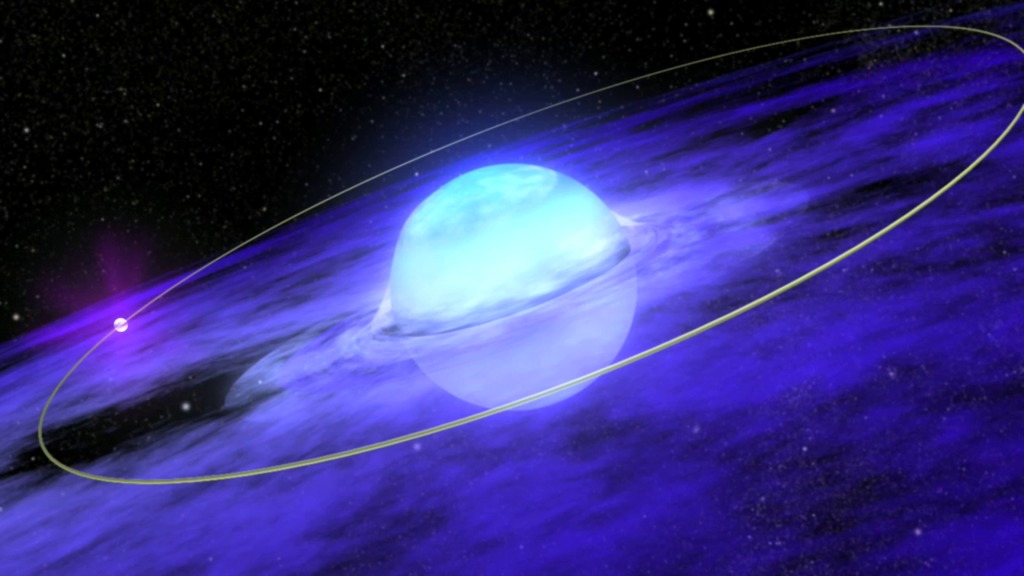
Many high-mass binary systems will wind up with a high-mass blue supergiant at the center of a system, which will eventually go supernova and produce a neutron star. A less massive star that orbits it can serve as a donor star: lending mass to the neutron star until it spins up and achieves hundreds of rotations per second. Over time, the mass distribution of the neutron star rearranges itself, leading to faster and faster rotations.
Credit: Walt Feimer, NASA/Goddard Space Flight Center
In addition to glitches, the observed shape of the radio pulse can change.

This image shows the illustration of a massive neutron star, along with the distorted gravitational effects an observer might see if they had the capability of viewing this neutron star at such a close distance. While neutron stars are famous for pulsing, not every neutron star is a pulsar. The fastest pulsars, known as millisecond pulsars, rotate at more than 100 times per second, with “glitches” speeding up the rotation rate of these pulsars.
Credit: Daniel Molybdenum/flickr and raphael.concorde/Wikimedia Commons
Pulse profile changes, once thought rare, definitely aren’t starquakes.

This observation of pulsar J0437-4715 shows the central pulsar/white dwarf combination, where the light output is dominated by the white dwarf component, and the faint red, looping structure that results from the combined magnetic field that the white dwarf and pulsar carve together.
The closest millisecond pulsar, PSR J0437-4715, is just 510 light-years away.

This figure shows the bow shock and ionization features associated with a bubble carved into the surrounding plasma by the combination of a white dwarf and a millisecond pulsar around the closest, brightest millisecond pulsar to Earth: PSR J0437-4715, four arcs, among more than 20 other features, exist within 5000 AU of the pulsar/white dwarf system.
It possesses a white dwarf companion.
Two pulse profile changes were recently reconstructed: in 2017 and 2022.

This graph shows (at least) two abrupt transitions in the pulse phase of the millisecond pulsar J0437-4715, with the central bright peak corresponding to the average pulse phase and the two leftmore peaks corresponding to the spontaneous changes that occurred in the pulse profile.
Combined with PSR 1713+0747’s similar change, polarization-based analyses favor magnetospheric, not seismic, origins.

This animation provides a tour around an isolated pulsar’s simulated magnetic field. In the presence of another highly magnetized object, such as a white dwarf, the field lines can easily become complex, can interact, and lead to magnetic reconnection events. If pulse timing is dependent on the surrounding magnetic field, this can influence the timing period of the pulsar.
Perhaps millisecond pulsars aren’t as stable, long-term, as once believed.
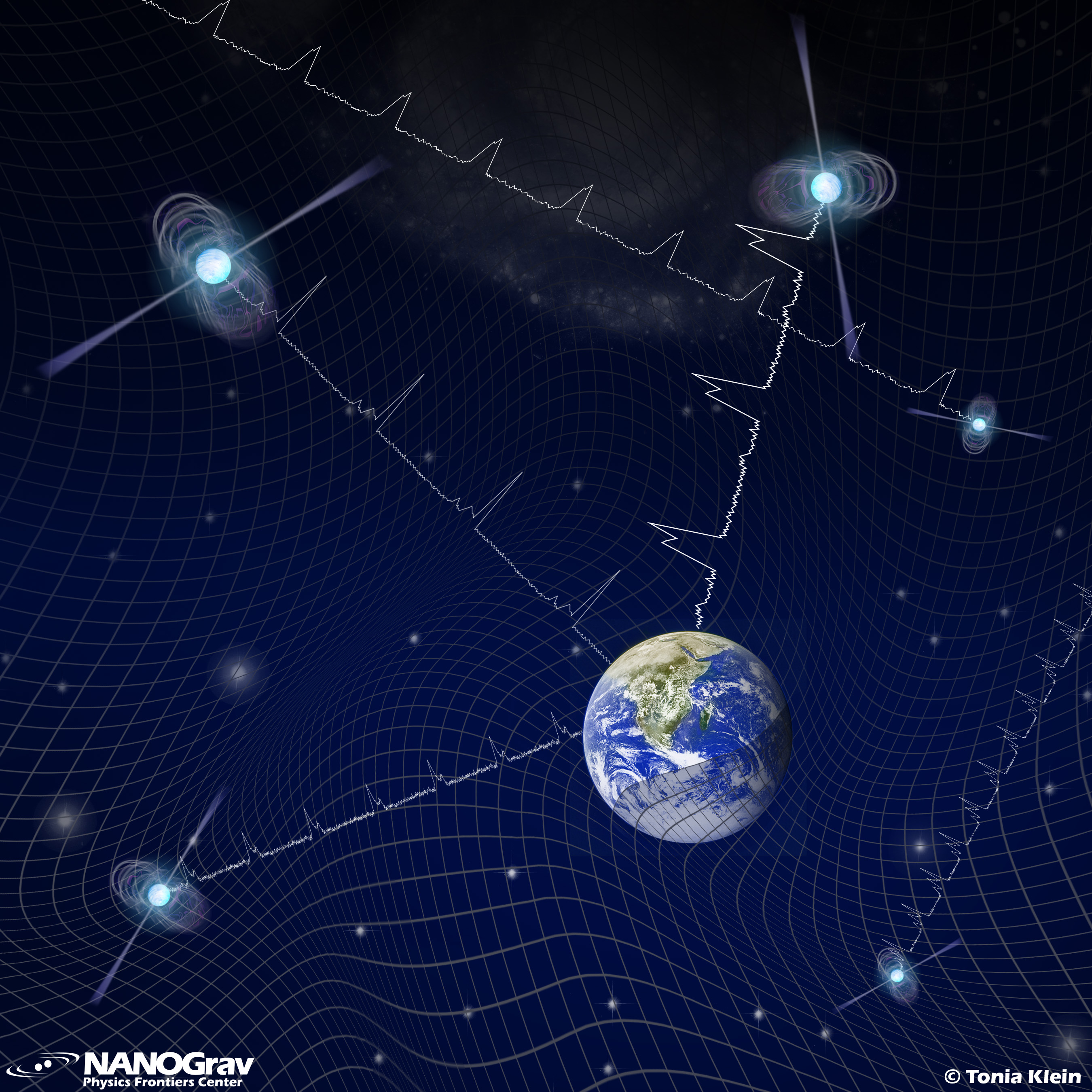
This illustration shows how the Earth, itself embedded within spacetime, sees the arriving signals from various pulsars delayed and distorted by the background of cosmic gravitational waves that propagate all throughout the Universe. The combined effects of these waves alters the timing of each and every pulsar, and a long-timescale, sufficiently sensitive monitoring of these pulsars can reveal those gravitational signals. If millisecond pulsars are less stable than thought, these pulse profile changes must be included in each pulsar’s evolution to successfully tease out any gravitational wave signals from the cumulative data.
Credit: Tonia Klein/NANOGrav
Mostly Mute Monday tells an astronomical story in images, visuals, and no more than 200 words.
Special Issue Summer 2026
The Opt-Out NationThis Big Think issue is a collection of stories about the American instinct to opt out, to pack up and go, to tell the boss, “I’d prefer not to.”
1 video 16 articles

Go deeper with Big Think Classes



| # | Наименование новости | Тональность | Информативность | Дата публикации |
|---|---|---|---|---|
| 1 | This discovery is why Einstein was history’s greatest physicist | 0 | 9.19 | 22-09-2026 |
| 2 | Hemos encontrado un fenómeno cósmico que desafía las leyes conocidas de la física estelar. Todo empieza con una estrella muerta | 0 | 7.3 | 25-09-2026 |
| 3 | 🎵⭐ ЗВЁЗДЫ, КОТОРЫЕ «ПОЮТ» ВО ВСЕЛЕННОЙ А вы знали, что ... | 0 | 6.24 | 16-09-2026 |
| 4 | Космические часы и «темные звезды»: как гравитационный шум раскрывает секреты ... | 0 | 7.32 | 01-09-2026 |
| 5 | Пульсары: космические часы с неожиданной нестабильностью Пульсары — это уникальные ... | 0 | 6.57 | 21-09-2026 |
| 6 | NASA’s Chandra and IXPE Study Pulsar in Lighthouse Nebula | 0 | 7 | 17-07-2026 |
| 7 | Квазары предпочитают моду семидесятых | 3 | 7 | 08-06-2020 |
| 8 | # Космический «маяк» раскрыл свои магнитные тайны: телескоп NASA IXPE ... | 0 | 7.89 | 04-08-2026 |
| 9 | УРА! Астрономы поймали странный сигнал из космоса. Они прямо сейчас ... | 0 | 9.36 | 16-08-2026 |
| 10 | Бозонные звёзды от Джона Уилера до наших дней | 0 | 10.63 | 26-07-2026 |

