Просмотр новости
Найдите то, что Вас интересует
 Спутники
 РН
РН SpaceX
 Роскосмос
 NASA
NASA
СпутникиРНSpaceXРоскосмосNASABy transforming urine into a valuable medical product, scientists hope to change how we view this human waste.
Most of us don’t think too much about what’s in our pee. We go, we flush, we forget. But that wastes a golden opportunity, some scientists say. They’re finding new — and quite valuable — uses for the chemicals in urine.
A recent study shows that some yeast can turn ingredients from urine into hydroxyapatite (Hy-DROX-ee-AP-eh-tyte). This calcium-based mineral makes bone hard.
Surgeons and dentists sometimes use it to repair bones and teeth. It also could help make sturdy building materials. And it’s worth more than past pee-based products.
“We’re taking a waste product and turning it into something high-value,” says Jeremy Guest.
He hopes his team’s findings may inspire cities to “manage waste in a new way.” Guest is an environmental engineer at the University of Illinois Urbana–Champaign. His team shared its new work May 6 in Nature Communications.
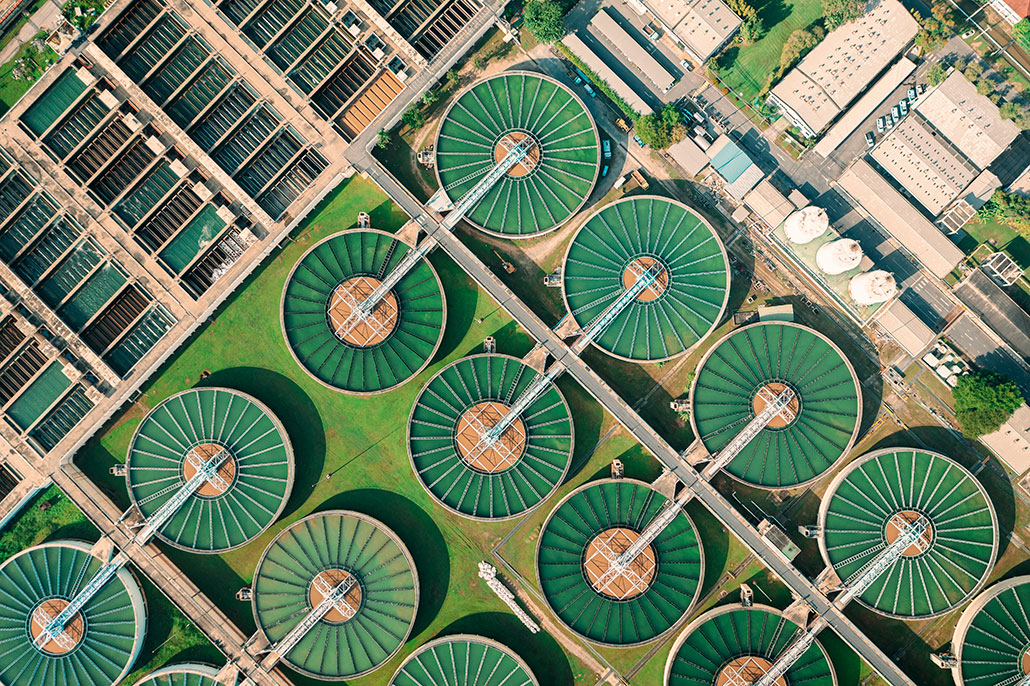 Today’s wastewater treatment plants treat pee as a problem rather than a potentially valuable resource. Create image/Moment/Getty Images
Turning tinkle into treasure
Today’s wastewater treatment plants treat pee as a problem rather than a potentially valuable resource. Create image/Moment/Getty Images
Turning tinkle into treasure
Cities today view pee as simply a problem to be solved. Sewage-treatment plants filter germs from water to stop the spread of disease. This cleaning also strips out elements in pee that could harm the environment. Nitrogen is one such contaminant. So is phosphorus.
But those elements aren’t necessarily bad, says Treavor Boyer. Most “contaminants are just chemicals in the wrong place at the wrong time.” Boyer is an environmental engineer at Arizona State University in Tempe. He did not take part in the new research. But he does study how we might recover resources from wastewater.
The nitrogen and phosphorus from urine can be used to make fertilizer, Boyer says. Urine’s breakdown also produces ammonia and urea. Many companies use these chemicals to make their products.
Changing how society views urine won’t be easy, though. Fertilizer, for instance, is not very costly. It’s hard to get nutrients from wastewater “and have the sale of the nutrient products [repay the costs of doing that],” explains Guest.
That’s why his team turned to hydroxyapatite. It’s made from the same stuff as fertilizer, but sells for more. That might motivate cities to revamp their water processing to harvest the mineral.
Tiny hydroxyapatite factoriesInspiration struck when a scientist in Peter Ercius’ lab noticed something strange. Ercius works at the Lawrence Berkeley National Laboratory (LBNL) in California. There, he looks at how materials change in liquids, such as inside living cells. To do that, he uses light and electron microscopes.
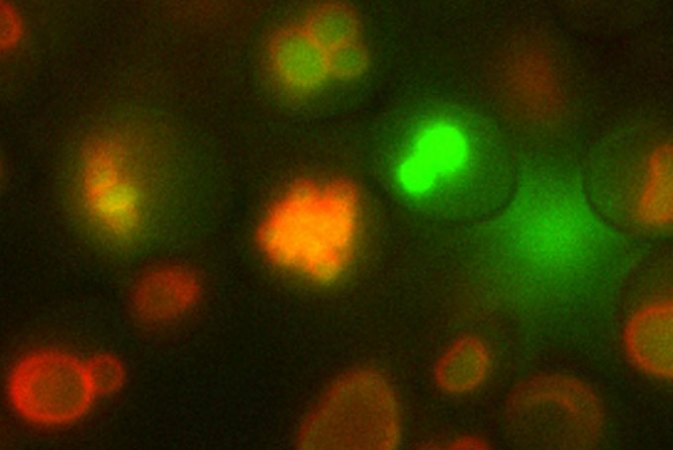 These microscope images show osteoyeast cells. The outline of the vacuole — the cell part where calcium builds up to form hydroxyapatite — is glowing red. The calcium inside the vacuole glows green.Berkeley Lab
His team had been looking at a yeast called Saccharomyces boulardii. “Yeast has been used for thousands of years,” notes Ercius. “It’s kind of been almost domesticated by humans.” People use it to make bread, for instance. “We know how to grow yeast, how to keep them alive, how to keep them happy.”
But his team wanted to know more about how this yeast works.
One day, a scientist in the lab spotted what looked like odd mineral buildup inside the yeast cells. “It’s probably not actually inside [the cells],” Ercius recalls thinking. But it was.
His team imaged the yeast from different angles. To work out what was going on, they also used colored dyes to track how materials moved in and out of the yeast.
They found the yeast were taking up minerals from the liquid around them.
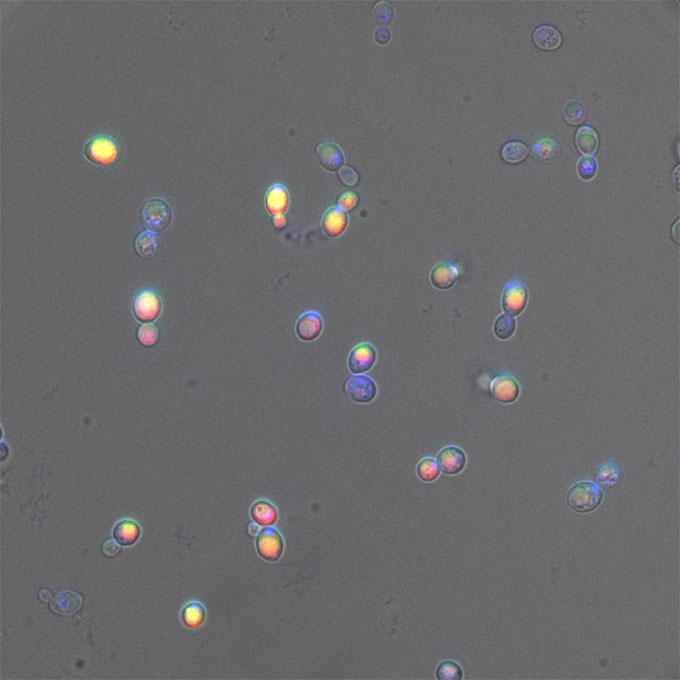 Scientists used colored dyes to work out how osteoyeast creates hydroxyapatite. The cells’ vacuoles are glowing red. Calcium appears green. Blue parts show where phosphate molecules are.Berkeley Lab
Yeast can absorb and release metal ions, says Behzad Rad. A biophysicist at LBNL, he worked on the yeast project. The yeast were cramming those materials into vacuoles — storage tanks inside their cells. Inside the vacuoles, the yeast crafted different chemical ingredients. When released from the cell, these chemicals crystallized into hydroxyapatite.
This process mimics how human osteoblasts, a type of bone cell, create this material. In honor of that, the scientists named their yeast cells “osteoyeast.”
Kai Udert is a systems engineer at the Swiss Federal Institute of Aquatic Science and Technology. It’s in Dübendorf. Though he did not take part in the new work, he does study how cities might recycle urine. Bacteria in toilets make hydroxyapatite from urine too, he notes. But the yeast’s process yields more of this mineral than bacteria do. And unlike bacteria, it doesn’t produce a bunch of other unwanted minerals on the side.
The yeast produced about 1 gram of the mineral from each liter (quart) of urine. Urine doesn’t naturally contain enough calcium to support this process, so the researchers added a bit extra.
Flush with possibilitiesGuest and his coworkers calculated how much their hydroxyapatite could sell for. Their estimate: between $19 and $138 per cubic meter (roughly 264 gallons) of urine. That’s about the volume of a refrigerator. The same pool of pee makes only about $12 to $33 worth of fertilizer. So cities could get a bigger profit from turning pee into hydroxyapatite.
Producing this product would require separating urine from other wastes in the toilet. The collected pee would go through a few treatment stages. Guest imagines that the urine and yeast might enter a stainless-steel tank. There, the yeast would use minerals from the pee to build hydroxyapatite.
Submit your question here, and we might answer it an upcoming issue of Science News Explores
That mineral could then be drawn from the tank. Everything else would go on to be treated like normal sewage. A processing center would sterilize — remove any germs from — the hydroxyapatite, Guest says. The purified mineral could then be turned into something useful.
Udert thinks these yeasts could have more outlandish — even out of this world — applications. On the International Space Station, for instance, astronauts already use a toilet that splits pee from poo. Wastewater is then recycled to make clean drinking water. Currently, a harsh chemical process achieves this. Perhaps, says Udert, the yeast could offer a safe, greener way to break down astronaut pee.
ammonia: A colorless gas with a nasty smell. Ammonia is a compound made from the elements nitrogen and hydrogen. It is used to make food and applied to farm fields as a fertilizer. Secreted by the kidneys, ammonia gives urine its characteristic odor. The chemical also occurs in the atmosphere and throughout the universe.
application: A particular use or function of something.
bacteria: (singular: bacterium) Single-celled organisms. These dwell nearly everywhere on Earth, from the bottom of the sea to inside other living organisms (such as plants and animals). Bacteria are one of the three domains of life on Earth.
calcium: A chemical element and alkali metal common in minerals of the Earth’s crust and in sea salt. It is also found in bone mineral and teeth, and can play a role in the movement of certain substances into and out of cells.
cell: (in biology) The smallest structural and functional unit of an organism. Typically too small to see with the unaided eye, it consists of a watery fluid surrounded by a membrane or wall. Depending on their size, animals are made of anywhere from thousands to trillions of cells. Most organisms, such as yeasts, molds, bacteria and some algae, are composed of only one cell.
chemical: A substance formed from two or more atoms that unite (bond) in a fixed proportion and structure. For example, water is a chemical made when two hydrogen atoms bond to one oxygen atom. Its chemical formula is H2O. Chemical also can be an adjective to describe properties of materials that are the result of various reactions between different compounds.
contaminant: Pollutant; a chemical, biological or other substance that is unwanted or unnatural in an environment (such as water, soil, air, the body or food). Some contaminants may be harmful in the amounts at which they occur or if they are allowed to build up in the body or environment over time.
electron microscope: A high-tech instrument that uses electrons, not light, to produce a magnified image of some structures. This type of microscope shows tinier details better than any other type.
element: A building block of some larger structure. (in chemistry) Each of more than one hundred substances for which the smallest unit of each is a single atom. Examples include hydrogen, oxygen, carbon, lithium and uranium.
engineer: A person who uses science and math to solve problems. As a verb, to engineer means to design a device, material or process that will solve some problem or unmet need.
environment: The sum of all of the things that exist around some organism or the process and the condition those things create. Environment may refer to the weather and ecosystem in which some animal lives, or, perhaps, the temperature and humidity (or even the placement of things in the vicinity of an item of interest).
environmental engineer: A person who uses science to study and solve problems in ecosystems — from forests to the human body.
environmental science: The study of ecosystems to help identify environmental problems and possible solutions. Environmental science can bring together many fields including physics, chemistry, biology and oceanography to understand how ecosystems function and how humans can coexist with them in harmony. People who work in this field are known as environmental scientists.
federal: Of or related to a country’s national government (not to any state or local government within that nation). For instance, the National Science Foundation and National Institutes of Health are both agencies of the U.S. federal government.
fertilizer: Nitrogen, phosphorus and other plant nutrients added to soil, water or foliage to boost crop growth or to replenish nutrients that were lost earlier as they were used by plant roots or leaves.
filter: (n.) Something that allows some materials to pass through but not others, based on their size or some other feature. (v.) The process of screening some things out on the basis of traits such as size, density, electric charge.
germ: Any one-celled microorganism, such as a bacterium or fungal species, or a virus particle. Some germs cause disease. Others can promote the health of more complex organisms, including birds and mammals. The health effects of most germs, however, remain unknown.
hydroxyapatite: A mineral containing calcium and phosphorus, found in human bone and the outer surface of human teeth.
International Space Station: An artificial satellite that orbits Earth. Run by the United States and Russia, this station provides a research laboratory from which scientists can conduct experiments in biology, physics and astronomy — and make observations of Earth.
ion: (adj. ionized) An atom or molecule with an electric charge due to the loss or gain of one or more electrons. An ionized gas, or plasma, is where all of the electrons have been separated from their parent atoms.
mineral: Crystal-forming substances that make up rock, such as quartz, apatite or various carbonates. Most rocks contain several different minerals mish-mashed together. A mineral usually is solid and stable at room temperatures and has a specific formula, or recipe (with atoms occurring in certain proportions) and a specific crystalline structure (meaning that its atoms are organized in regular three-dimensional patterns). (in physiology) The same chemicals that are needed by the body to make and feed tissues to maintain health.
nitrogen: A colorless, odorless and nonreactive gaseous element that forms about 78 percent of Earth's atmosphere. Its scientific symbol is N.
nutrient: A vitamin, mineral, fat, carbohydrate or protein that a plant, animal or other organism requires as part of its food in order to survive.
osteoblast: The type of cell used by the body to make new bone tissue.
phosphorus: A highly reactive, nonmetallic element occurring naturally in phosphates. Its scientific symbol is P. It is an important part of many chemicals and structures that are found in cells, such as membranes, and DNA.
recall: To remember.
recycle: To find new uses for something — or parts of something — that might otherwise be discarded, or treated as waste.
sewage: Wastes — primarily urine and feces — that are mixed with water and flushed away from homes through a system of pipes for disposal in the environment (sometimes after being treated in a big water-treatment plant).
urea: A nitrogen-rich chemical that the bodies of many animals produce after breaks down proteins, amino acids (the building blocks of proteins) or ammonia. People excrete excess nitrogen from the body — as urea — in urine. But many other mammals, amphibians and fish make urea as well. Synthetic urea is often a nitrogen source of plant fertilizers. In 1828, German chemist Friedrich Wöhler for the first time created urea in the laboratory. This discovery would lead to the widespread use of synthetic fertilizers in farming.
vacuole: A large compartment in a cell.
waste: Any materials that are left over from biological or other systems that have no value, so they can be disposed of as trash or recycled for some new use.
wastewater: Any water that has been used for some purpose (such as cleaning) and no longer is clean or safe enough for use without some type of treatment. Examples include the water that goes down the kitchen sink or bathtub or water that has been used in manufacturing some product, such as a dyed fabric.
yeast: One-celled fungi that can ferment carbohydrates (like sugars), producing carbon dioxide and alcohol. They also play a pivotal role in making many baked products rise.
A version of this article appears in the December 1, 2025 issue of Science News Explores.
About Katie Grace Carpenter
Katie Grace Carpenter is a science writer and curriculum developer, with degrees in biology and biogeochemistry. She also writes science fiction and creates science videos. Katie lives in the U.S. but also spends time in Sweden with her husband, who’s a chef.
| # | Наименование новости | Тональность | Информативность | Дата публикации |
|---|---|---|---|---|
| 1 | 85 новых случаев коронавируса выявлено у пассажиров лайнера в Японии | 0 | 0 | 17-02-2020 |
| 2 | Балтийск: День 1 ноя, Чт | 0 | 0 | 31-10-2018 |
| 3 | Draft Angle check | 0 | 0 | 22-12-2017 |
| 4 | Агидель: Ночь 20 дек, Чт | 0 | 0 | 19-12-2018 |
| 5 | Глава 13 "Подозрения и Обман": Джокер и голубь с большой ... | 0 | 0 | 21-02-2025 |
| 6 | В Кузнецке прошел городской конкурс «А ну-ка, парни!» | 0 | 0 | 21-02-2025 |
| 7 | ☝Мамы, хотите действительно отдохнуть и не думать как накормить любимых, ... | 5 | 6 | 29-06-2026 |
| 8 | ABC: Трамп рассматривает возможность отставки главы аппарата Белого дома | 0 | 0 | 13-11-2018 |
| 9 | Уважаемые односельчане ! В преддверии празднования 80 - летия Великой ... | 0 | 0 | 21-02-2025 |
| 10 | Scientists Say: Clone | 0 | 10 | 20-04-2026 |