Просмотр новости
Найдите то, что Вас интересует
 Спутники
 РН
РН SpaceX
 Роскосмос
 NASA
NASA
СпутникиРНSpaceXРоскосмосNASANearly two-thirds of states (plus the District of Columbia and Puerto Rico) have an Earned Income Tax Credit. These credits boost low-paid workers’ incomes and offset some of the taxes they pay, helping working class families achieve greater economic security.
The Earned Income Tax Credit (EITC) boosts low-paid workers’ incomes and offsets some of the taxes they pay, helping lower-income families achieve greater economic security. The federal EITC – which celebrated its 50th anniversary in 2025 – has kept millions of Americans above the poverty line since its enactment in the mid-1970s. Over the past several decades, the EITC’s effectiveness has been amplified as many states have enacted and strengthened their own credits.
Five years ago, the success of the federal American Rescue Plan Act in reducing child poverty through expansions to the federal EITC and CTC prompted many states to expand their own credits despite the federal expansion lapsing. Since 2021, four states created new EITCs and 22 states and the District of Columbia expanded their existing EITCs.1
This year, Oregon and Washington became the most recent states to enhance their existing credits. In Washington, lawmakers doubled the reach of the Working Families Tax Credit to an additional 460,000 households, thanks to new revenue from the state’s millionaires’ tax. In Oregon, lawmakers increased the state’s EITC from 9 to 14 percent for individual filers and from 12 to 17 percent for filers with a child under 3.
South Carolina lawmakers, in contrast, enacted a $200 cap on their nonrefundable EITC, further limiting the credit’s impact, as part of their effort to pay for personal income tax cuts passed this year.
The effects of the EITC have been studied for decades, and research consistently shows that children whose families received the credit are more likely to graduate from high school, go to college, and be employed as adults.2 In addition to boosting financial security for working families with children, the EITC also improves health outcomes and is connected to a reduction in babies born with low birthweights.3
The EITC benefits low-income workers of all races and ethnicities. It is particularly beneficial to Black and Hispanic communities where discrimination in the labor market, underfunded education systems, and countless other inequities have relegated a disproportionate share of people to low-paid jobs.
Proven and effective income supports like the EITC are more important than ever. Too many workers face low and slow-growing wages while simultaneously facing high costs for housing, childcare, and other basic expenses. In roughly 40 states, low-income households also pay a higher share of their incomes in state and local taxes than the richest households.4 This leaves working families with even fewer resources to make ends meet and contributes to our nation’s growing income and wealth inequality.
These outcomes will only be compounded by the 2025 federal tax and spending law, which will cut services many EITC-eligible families use to make ends meet for their families. Creating or expanding a state EITC can help counteract inequities in state tax codes while boosting the incomes of low- and moderate-income workers.
Federal Earned Income Tax Credit Provides Income Boost to MillionsThe federal EITC has been boosting the incomes of low-paid workers and working-class families for over 50 years, since 1975. Lawmakers have improved the credit over time so more working families can put food on the table, pay their bills, and benefit from increased economic stability.
The federal EITC delivered about $69.6 billion to 24 million working families and individuals in 2024 through claims on their 2024 tax returns.5 The federal EITC and the federal Child Tax Credit combined lifted an estimated 6.1 million out of poverty in 2025.6
Although the EITC does a lot to reduce poverty, a more robust EITC did so to a greater extent in 2021. As a response to the COVID-19 pandemic, the American Rescue Plan Act temporarily increased the federal EITC for low-paid workers without children in the home and made it more widely available by expanding age and income limits. These enhancements expired on January 1, 2022.
The improved federal EITC delivered about $60 billion to 25 million working families and individuals in 2021. The stronger federal EITC, together with an enhanced federal Child Tax Credit in place for 2021, lifted an estimated 9.6 million people out of poverty in 2021 compared to 6.1 million in 2025.7
The EITC is based on earned income like salaries and wages. For each dollar earned up to $18,290 in 2026, families with three or more children will receive a tax credit equal to 45 percent of those earnings, up to a maximum of $8,231 The credit is designed to boost incomes for low- and moderate-income workers, phasing out as incomes rise. Families are eligible for the maximum credit until income reaches $23,890 for single heads of household. Above this level, the credit gradually decreases and becomes unavailable when family income exceeds the maximum eligibility level which is $62,974 for single-parent households with three or more children and $70,244 for married couples. The credit is small and not widely available for workers without children in the home—a group that includes noncustodial parents whose children live the majority of the year with another parent: the maximum credit for these workers is $664.
State Earned Income Tax Credits Help Low-Paid Workers and Improve State Tax SystemsIn addition to helping working families afford childcare, healthcare, housing, food, and other necessities, state EITCs improve state and local tax systems.
Unlike federal taxes, state and local taxes are regressive, requiring low- and moderate-income families to pay a greater share of their incomes than wealthier taxpayers. This is true of state and local taxes as a whole, as well as in most states. The poorest 20 percent of Americans pay 11.4 percent of their incomes in state and local taxes. By contrast, middle-income taxpayers pay 10.5 percent, and the wealthiest 1 percent of taxpayers pay just 7.2 percent.8
Regressive sales and property taxes (which all working families pay whether renting or owning property) create the high state and local tax rates faced by the poorest households. A refundable state EITC is among the most effective and targeted strategies to help counterbalance these regressive taxes.
Refundability is vital because it ensures that workers and their families get the full benefit of the credit. Refundable credits do not depend on the amount of income taxes paid; rather, if the credit exceeds income tax liability, the taxpayer receives the excess as a refund. This makes these credits more effective at offsetting regressive sales and property taxes and at boosting incomes. This is essential because for lower-income families, sales and property taxes—not income taxes—make up the bulk of state and local taxes paid.
Nearly two-thirds of states (32 states plus the District of Columbia and Puerto Rico) offer EITCs (see Appendix). With a few exceptions (California, Minnesota, and Washington), taxpayers calculate their state EITC as a percentage of the federal credit. In many ways, this makes it easy for people to claim the credit (since they have already calculated their federal credit) and straightforward for state tax administrators.
There are, however, good reasons to decouple from aspects of the federal credit. This includes decoupling from policies that prohibit certain immigrant groups from receiving their full credit, extending benefits to immigrant taxpayers filing with Individual Taxpayer Identification Numbers (ITINs) who do not qualify for the federal credit, and strengthening benefits for workers without children in the home or in extremely low-income families.
States vary dramatically in the generosity of their credits. The EITC provided by the District of Columbia, for example, is 85 percent of the federal credit this year for most eligible families, increasing to 100 percent in 2029 (matching its existing 100 percent credit for workers without dependents in the home).
Figure 1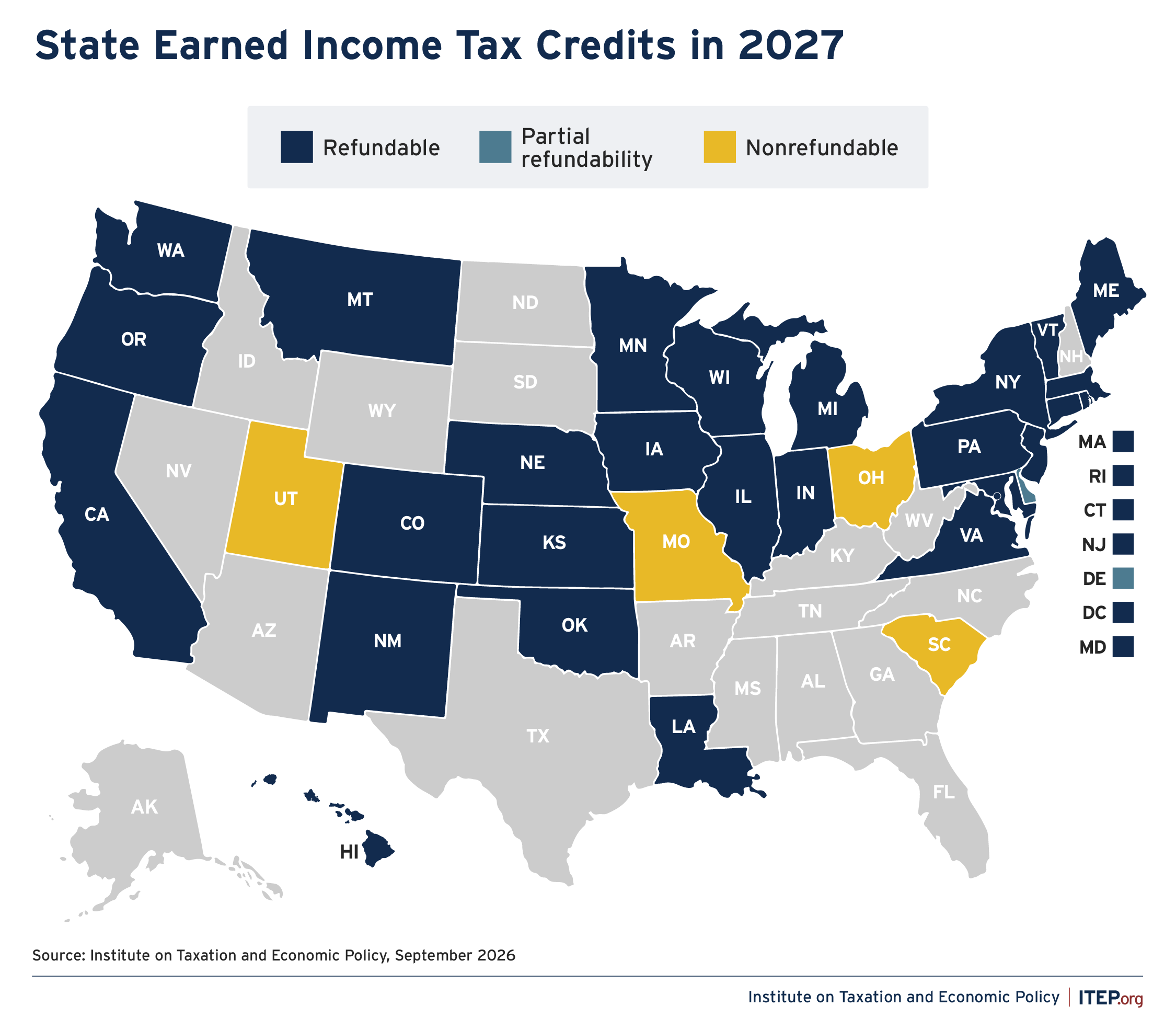
Meanwhile, three states (Delaware, Louisiana, and Oklahoma) have refundable EITCs that are worth less than 10 percent of the federal credit. Four other states (Missouri, Ohio, South Carolina, and Utah) allow only a nonrefundable credit, which limits the ability of the EITC to offset regressive state and local taxes. Delaware is now the only state to offer partial refundability, which allows taxpayers to choose between a refundable or nonrefundable credit. Beginning in 2025, Virginia moved to a fully-refundable credit structure through 2030.
Recent Progress Toward Expanded EITCsState lawmakers have made the creation and enhancement of EITCs a priority in recent years. The American Rescue Plan Act significantly expanded refundable credits like the EITC in 2021, and state lawmakers quickly understood the impact this had in helping workers and families make ends meet. While federal lawmakers failed to extend these expansions beyond 2021, state legislators picked up the baton and accelerated the creation and improvement of state-level refundable credits. Since 2021, 23 states and the District of Columbia have enacted or boosted EITCs. Thirteen of these states have boosted their credits multiple times over that period.
Figure 2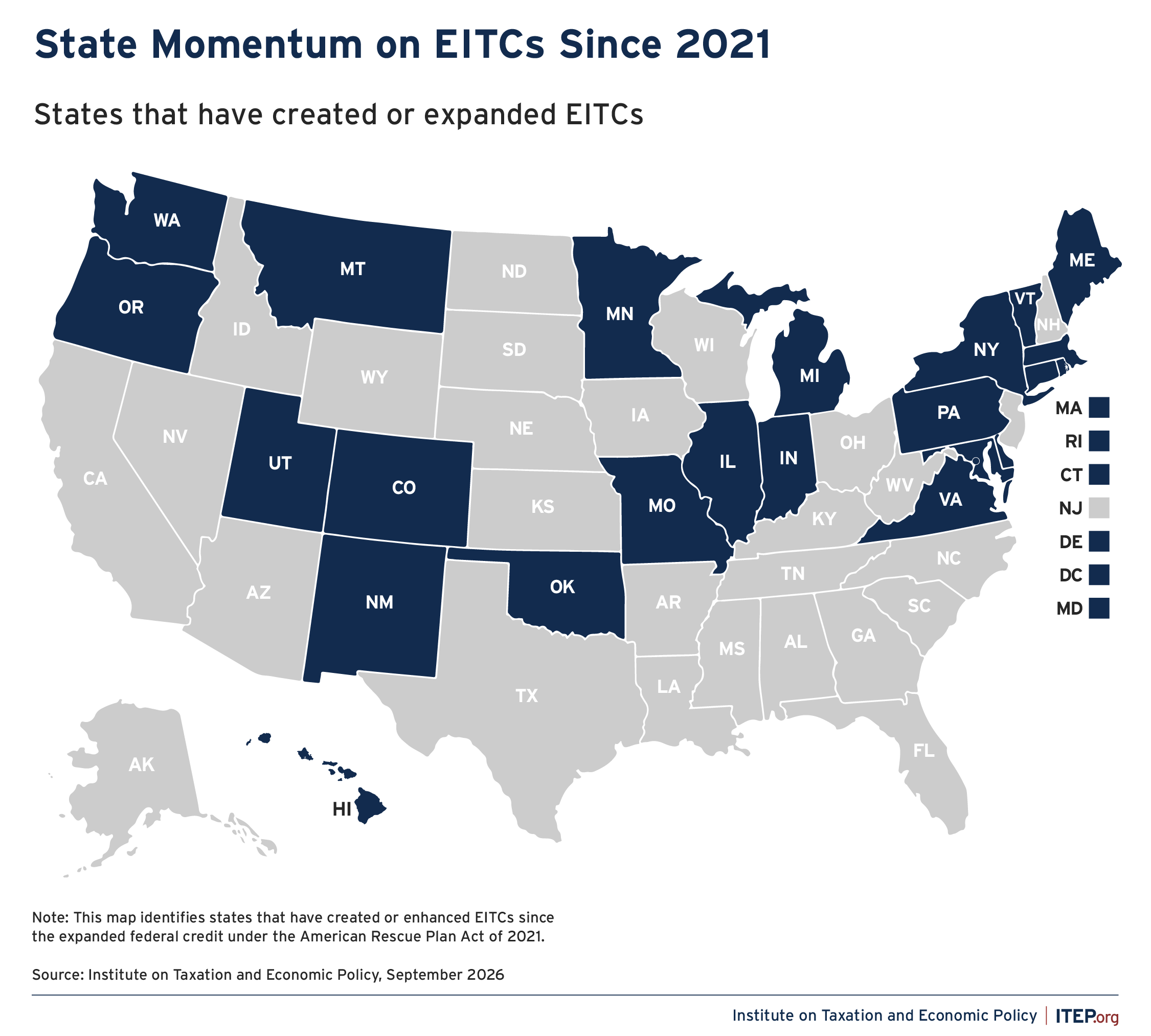
Two states expanded or increased their EITCs in 2026.
Lawmakers in Oregon increased its credit amount from 9 to 17 percent for filers with a child under 3 years of age and from 12 to 14 percent for other filers.
Washington passed an expansion to its EITC (or Working Families Tax Credit) that will go into effect in 2029. The changes will allow all filers who are 18 and older to claim the credit. This is more generous than the federal credit which excludes people under the age of 25 or over the age of 65 unless they have children living in the home. Washington is also expanding the income to qualify for the credit by tying it to the state’s “Need Standard,” a comprehensive cost of living metric developed by the state’s Department of Social and Health Services. These changes will allow 460,000 more Washington households to qualify for the state’s EITC.9
There are several best practices for states looking to increase the impact of their EITCs:
These actions can chip away at racial and wealth inequality, blunt some of the regressivity of state and local tax systems, and help families meet their basic needs. Lawmakers should enact and strengthen state EITCs with these concepts in mind.
In recent years, the District of Columbia and Washington state have exemplified EITC best practices. D.C. set the standard for boosting and expanding state credits to surpass the federal EITC (a move to 100 percent of the federal credit for all filers in 2029, plus expanded income eligibility). Part of D.C.’s EITC will also be available to recipients in monthly payments.
Washington modeled its Working Families Tax Credit after the federal EITC and enhanced it by allowing all families with any amount of earned income to qualify for the credit’s full value. The move this year to expand income eligibility and extend the credit to all qualifying individuals age 18 and older demonstrates again Washington state’s commitment to EITC best practices.
Expanding Eligibility to Immigrant WorkersMuch like their neighbors, undocumented immigrants pay sales and excise taxes on good and services like utilities, household products, and gasoline. They pay property taxes either directly on their homes or indirectly when these taxes are folded into their monthly rent. And they pay income and payroll taxes through automatic withholding from their paychecks or by filing income tax returns using Individual Taxpayer Identification Numbers (ITINs), tax processing numbers made available to certain immigrants, their spouses, and their dependents who do not have Social Security Numbers (SSNs). This allows these noncitizens who live and work in the United States to pay local, state, and federal taxes; our analysis found they contributed $96 billion in 2022.11
Immigrants have often been excluded from key federal policies even when meeting other eligibility requirements. For example, the version of the tax code confronting noncitizen filers is actually harsher than the one faced by U.S. citizens.12 Among the reasons for this is the fact that noncitizens are barred from claiming the federal EITC.13
While most states mirror this provision in their own tax codes, one-third of the states with EITCs have opted for a more inclusive approach that allows families filing with ITINs to claim the state EITC.
Figure 3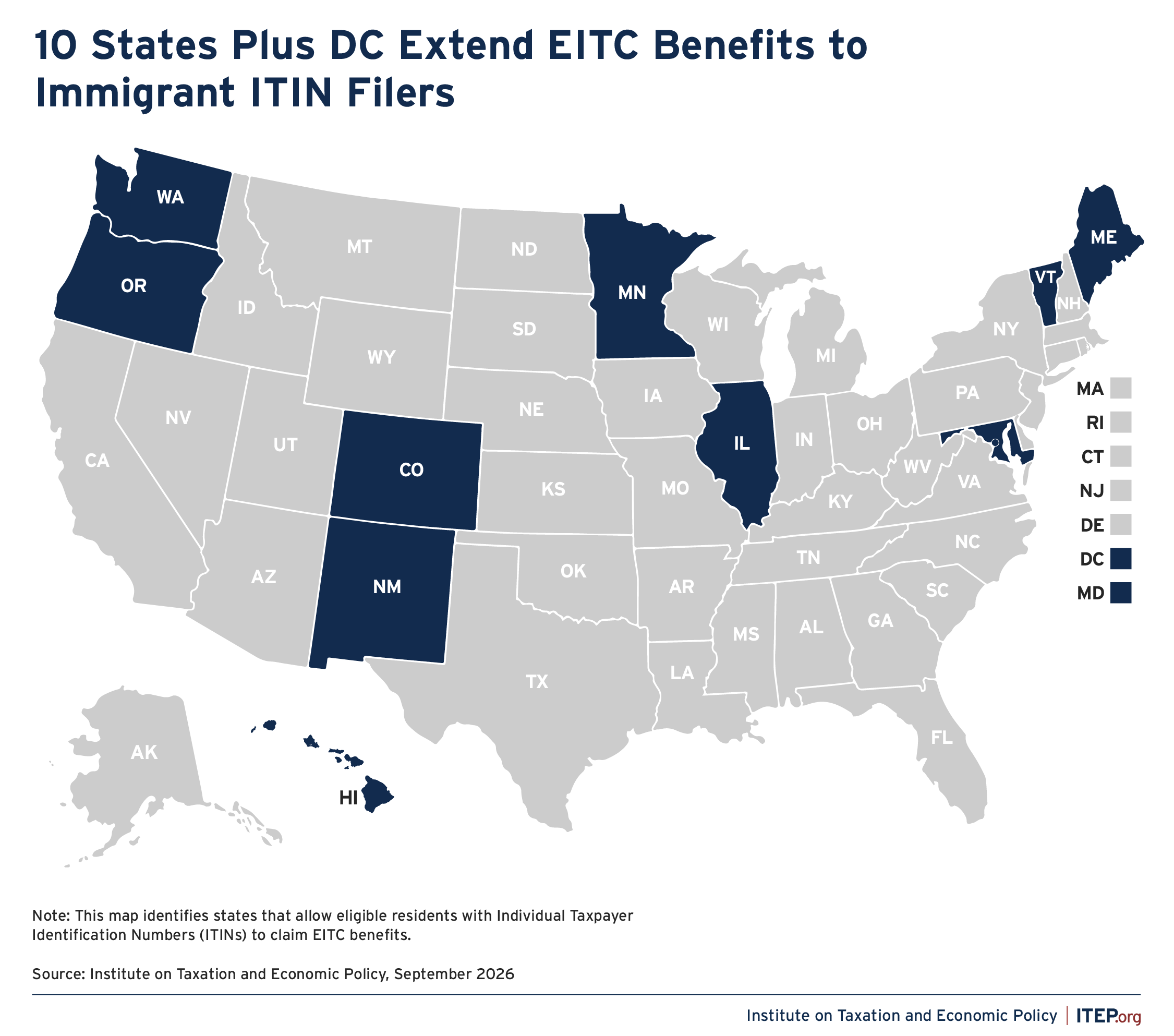
Since 2020, California, Colorado, Illinois, Maine, Maryland, Minnesota, New Mexico, Oregon, Vermont, Washington, and the District of Columbia have adopted this reform, bringing the tax treatment of noncitizens more in line with the treatment of most other people living in the U.S.
New Regulatory Action May Drastically Cut State EITCs for Lawfully Present Immigrants.Unfortunately, new proposed regulations from the U.S. Treasury Department and IRS would strip eligibility for the refundable portion of the federal EITC from certain immigrant groups. Because the EITC already requires the taxpayer to have a valid Social Security Number (SSN) as a condition of eligibility, the proposal is targeted squarely at lawfully present immigrants who are authorized to work in the U.S. Groups at risk include DACA recipients brought to the country as children, immigrants with Temporary Protected Status, and asylum applicants.14
The vast majority of state EITCs match a percentage of what a filer receives from their federal credit, so this regulation runs the risk of reducing what many immigrants receive from their state EITC. For example, a DACA recipient who typically receives a federal EITC of $3,000, of which half is refundable, would now only receive a federal EITC of $1,500 under this new regulation. At the state level, if this taxpayer lived in Colorado for instance, their 25 percent state-level EITC would be reduced from $750 to $375.15
Failure to decouple from this regulation, if it is finalized and upheld by the courts, would harm lawfully present immigrants and their families who are working and filing taxes using a valid SSN. It would also lead to arbitrary and nonsensical results in state tax codes.
For example, in the 10 states plus D.C. that extend their EITCs to taxpayers filing with an ITIN, it is possible that lawfully present immigrant tax filers who file with a SSN would receive a reduced state credit, while undocumented immigrants filing with an ITIN would receive their full EITC.
Inconsistent treatment of immigrant groups aside, the policy also does not translate well to state tax codes. Eliminating refundability of the EITC at the federal level does not force the credit to be nonrefundable at the state level—instead, it merely reduces the state EITC by the same percentage that the federal EITC happened to be reduced. Rather than eliminating state refundability, conformity to these regulations would have inconsistent impacts across filers. Some filers would see reduced refundable credits or nonrefundable credits, and others could see their EITC wiped out entirely.
Expanding Age Eligibility and Increasing the Credit for Childless WorkersA growing number of states have chosen to expand the EITC for workers without children in the home. While the federal EITC provides strong support to families with children, its impact is limited for those without children: the maximum credit is much smaller and the income limits are more restrictive. For instance, a worker without dependent children in the home who is working full-time at the federal minimum wage is ineligible for the EITC. Under the current federal income tax system, these low-paid workers are taxed deeper into poverty.
The temporary expansion of the federal EITC in the American Rescue Plan Act of 2021 expanded age eligibility to include both younger and older low-income workers without dependent children. That expansion was allowed to lapse, however, meaning that once again the federal EITC excludes people under age 25 and over age 64 unless they have children in the home.
These workers include noncustodial parents, young workers getting a foothold in the job market, and older workers who need to work past the traditional retirement age and who often struggle to make ends meet.16 Because state EITCs are generally linked to the federal credit, these workers are excluded from most state EITCs as well.
Figure 4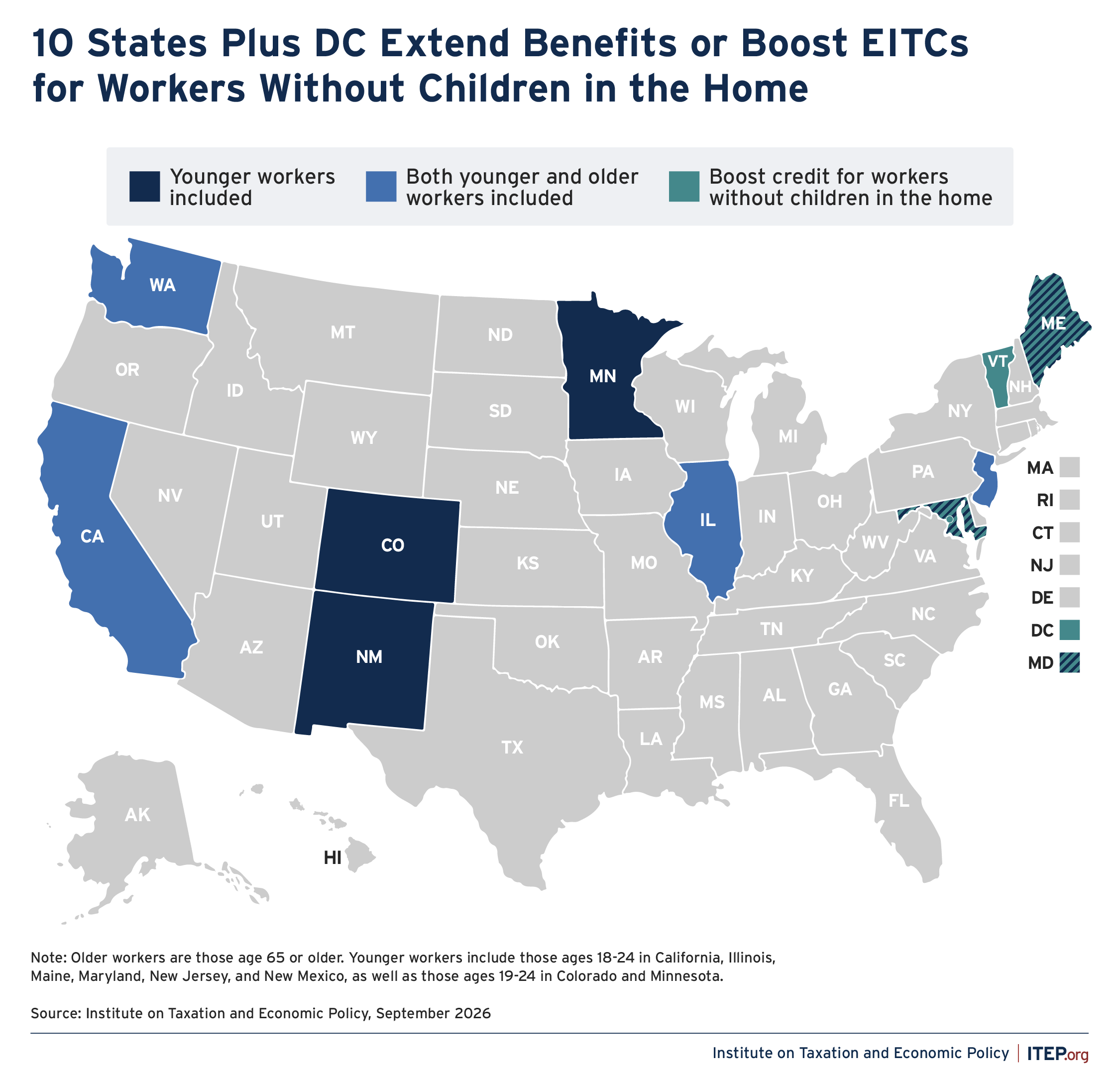
Nine states now recognize the need to provide more young workers the benefits of the EITC. And four states have expanded access to include older workers (ages 65+) without dependent children in the home. Most of these credit expansions for childless workers have occurred in the last few years.
For instance, this year, Washington lawmakers passed legislation to extend their credit’s eligibility to all filers 18 and older, effective 2029. Many states preceded Washington in expanding their credit for workers without dependent children in the home. Lawmakers in Illinois lowered the state’s minimum age of eligibility to 18 and expanded the credit to those 65 and older. Maine lawmakers doubled the credit size for their childless population from 25 to 50 percent of the federal level. Maryland, New Jersey, and New Mexico permanently lowered the age floor on their existing credits to include 18- to 24-year-old workers without dependents. California and Maine also include workers between the ages of 18 to 24 without children in the home, while Colorado and Minnesota set their age eligibility floor at 19.
Local EITCsA few localities have their own version of an EITC, most notably New York City and Maryland’s Montgomery County.17 These are provided on top of state credits, delivering an added boost for low-income working families who qualify for the EITC.
In New York City, a local EITC matches between 10 and 30 percent of the federal EITC, with the highest match rates to households with very low incomes. A low-income worker in New York City can receive a combined state and local boost worth up to 60 percent of the federal EITC.
In Montgomery County, a refundable EITC matches 25 percent of the federal EITC for families and 56 percent of the federal EITC for workers without children in the home. A low-income worker in Montgomery County can receive a combined refundable state and local boost worth 70 percent of the federal EITC for families with children and 156 percent of the federal EITC for workers without children. In addition, all Maryland counties and the city of Baltimore provide nonrefundable EITCs to offset local income taxes.
State lawmakers should ensure that localities are given the autonomy to create their own EITCs, and local lawmakers should consider pursuing these credits to bolster the economic security of residents working low-paid jobs.
| # | Наименование новости | Тональность | Информативность | Дата публикации |
|---|---|---|---|---|
| 1 | State Child Tax Credits Will Boost Financial Security for Families and Children in 2027 | 0 | 6.49 | 15-09-2026 |
| 2 | State Action on Child Tax Credits and Earned Income Tax Credits Since 2021 | 0 | 5.6 | 27-08-2026 |
| 3 | New EITC Proposal Would Help Families Dealing with Rising Costs | 0 | 5.96 | 30-04-2026 |
| 4 | Некоторые россияне с 2027 года станут автоматически получать налоговые льготы | 2 | 6 | 21-07-2026 |
| 5 | Депутаты предлагают распространить налоговый «кешбэк» 7% НДФЛ на все малообеспеченные семьи с 2027 года | 0 | 13.89 | 19-08-2026 |
| 6 | Bipartisan bill aims to boost paid family leave | 0 | 8.49 | 31-07-2026 |
| 7 | Эксперты: новые налоговые льготы незначительно повлияют на бюджеты регионов | 0 | 0 | 05-03-2019 |
| 8 | В России семьям с детьми вернут часть уплаченных налогов при невысоком доходе | 0 | 0 | 28-08-2025 |
| 9 | Успеть получить до 1 октября: новую налоговую поддержку оформили родители 2,7 млн детей | 0 | 19.68 | 17-08-2026 |
| 10 | Предприниматели смогут получить субсидию на зарплаты при погашении долга по налогам | 0 | 0 | 14-05-2020 |